Showing posts with label Bristol Aerospace. Show all posts

Wednesday, January 12, 2022

Red collar

Years ago I bought Dad a nice golf shirt with a red collar, and was surprised at how delighted he was with it. It became a favourite that he wore often. 

Murray Fraser in 1981

He told me why. At Bristol, a red collar on your shop coat meant you were a supervisor. We can see that in this 1956 photo taken for his ID card:

Employee 2795, February 1956, sporting a shop coat with a red collar.

Murray Fraser was a charge hand in the Tooling department at the time, with a staff of 29.

As he moved up the career ladder, the shop coat was replaced by a business suit. The man with the red collar became a white collar employee in the offices upstairs. 

In August, 1960 Dad was promoted to an Engineering Assistant and transferred to the Planning Department. Within three years he was a Senior Manufacturing Planner, and was a Manufacturing Engineer in the Manufacturing Projects Planning department (623) when he retired in June, 1982.

He earned the title, but called himself a Production Planner.

The white collar ranks.
"With a slide rule and model plane at hand, an engineer at Bristol Aero Industries Limited checks his figures."
[Winnipeg Free Press, May 21, 1960]

March is National Engineering Month. It is a good time to remember innovative planners and engineers like Dad. 


Dad was known for his innovative solutions and improvements in engineering methods at Bristol. In completing a 1973 company questionnaire to update job descriptions, Dad wrote that, "Another example of a new planning concept was the improved method and new dies designed and developed for the production of the swirl cup (J85 annular combustion liner), resulting in a unit standard time 1/25 of the 'old' method." [1]

Consider the importance of the J85 engine. Rick Kennedy, an author on the GE Aviation blog, praised the turbojet in a June 2020 article entitled "Long Live the J85, GE's 'Little Tough Guy' " [2]: 

No engine in jet propulsion is quite like GE's tiny J85 turbojet. Originally designed in 1954, the J85 is expected to power U.S. military aircraft until at least 2040. 

That's not a typo: GE had delivered more than 12,000 J85 engines and its commercial engine variants by the end of its production run in 1988. Yet the U.S. Air Force and NASA expect to keep J85-powered trainer jets in operational service until 2040 and beyond. That means the J85 will be in operational service for 85 years!

Not bad for a jet engine that's all of 18 inches wide and 45 inches long. For many years, the J85 had the highest thrust-to-weight ratio (8:1) of any jet engine in aviation.

That's a lot of swirl cups. And, while we're discussing the J85, Dad also designed what he termed the "Murray Fraser Automatic Index" to drill holes in the engine's afterburner. It simplified and standardized machining, resulting in less waste, more precision, yet much faster production. Dad's hand-written note on the margin of his blueprint claims it reduced machining time from 21 minutes to 12 minutes per part.  [3]

These are only two examples of Dad's approach to engineering that saved time and money for the company. No doubt it polished the Bristol reputation, too!

Bristol valued this kind of engineering approach, noting that, "One of the key factors in a successful Engineering Group is the Manufacturing Planning and Methods Dept. which functions as a Technological Advisory Group for management decision making processes and as a definition and control body for 'All In-House' production activities. [...] The production efficiency and capabilities of a complete factory can be measured against the skill and initiative or otherwise of its Planning Staff." 

As Dad wrote, "Major difficulties and problems are the daily routine of a planner." A planner must "keep his cool and objectivity in the face of disaster and criticism, and select the best way out without panic, bias or false pride. Sometimes an honest painful reappraisal indicates a scheme should be abandoned and a new 'back to the drawing board' approach taken."

Dad was serious about his work, but would have laughed heartily (with Bill Habington, no doubt) at the following ode to a machine designer:

The Designer  [4]

The designer bent across his board,
Wonderful things in his head were stored.

And he said, as he stroked his throbbing bean,
"Now, how can I make this thing hard to machine ?"

If this piece here were only straight,
I know this thing would work first rate.

But 'twould be so easy to turn and bore,
It would never make the machinists sore.

I'll just put in a right angle there,
Now watch those guys tear out their hair !

I'll put the holes that hold the cap
Way down here where they're hard to tap.

This piece won't work, I'll bet a buck,
'Cause it can't be held in a clamp, a vise, a shoe or a chuck.

It can't be drilled and it can't be ground,
In fact the design is exceedingly sound.

He looked again and he cried, "At last, 

Success is mine ! It can't even be cast !"


Sources (retrieved January 12, 2022)

[1]  "Joe's Swirl Cup," http://frasertrunk.blogspot.com/2012/07/joes-swirl-cup.html 

[2]  Rick Kennedy, "Long Live the J85, GE's 'Little Tough Guy' " GE Aviation blog, June 2020, https://blog.geaviation.com/technology/long-live-the-j85-ges-little-tough-guy 

[3]  "Kaizen!," http://frasertrunk.blogspot.com/2013/12/kaizen.html 

[4]  "The Designer," attributed to Ken Lane-Winthrop of the Boston Globe, reproduced in Joseph A. Davies "Naval Ordnance Planning," The Tool Engineer, Volume X, No. 4, April 1941, p. 73; https://books.google.ca/books?id=QpgjAAAAMAAJ&pg=RA3-PA73&lpg=RA3-PA73&dq="Ken+Lane"+"Boston+Post"&source=bl&ots=8ez6HlKTBv&sig=ACfU3U2IrHJ2kkCaPIazNrMMqFQ2kmmFkw&hl=en&sa=X&ved=2ahUKEwjOg__azqX1AhXUWc0KHRyCDGAQ6AF6BAgCEAM#v=onepage&q="Ken Lane" "Boston Post"&f=false


Sunday, October 24, 2021

Keep ’em flying

“Keep ’Em Flying” was coined on May 17, 1941 by the U.S. Army’s chief recruiting officer, Lt. Col. Harold N. Gilbert. The simple slogan was an effective, patriotic battle cry introduced by the U.S. War Production Board to inspire WWII aircraft factory workers. [1] The motto was popular and versatile, just what a public relations campaign needed.

A poem by Jack Childs entitled “Keep ’Em Flying” was published on a 1941 poster by artist C.C. Beall issued by the United States Army Recruiting Service. The slogan encouraged recruitment and civilian participation in the war effort. [2]

Keep ’Em Flying

Keep ’em flying—
            Airplanes—flags—
Machines—production—
            Nothing lags. 
Put your shoulder
            To the wheel;
Courage staunch
            With nerves of steel.
Greet each day,
            Or pledge a toast—
“Keep ’em flying”
            Is our boast.
Here’s a slogan
            For us all—
An answer to

           Our country’s call.

Keep ’em flying;
            Keep ’em clear.
The time is ripe,
            The time is HERE.
To pull together—
            One bold front—
Each one prepared
            To do his stunt.
Workers and
            The men who hire—
Housewives—children—
            All aspire
To help and work
            With little pause—
One mind, one heart,
            One goal, one cause.


SO—“KEEP ’EM FLYING!”


A typical U.S. Army recruitment poster, 1942.  [3]

The slogan was versatile and adaptable, all right. Every citizen was encouraged to support the war effort, even Miss U.S.A.

Uncle Sam needs stenographers! Imagine the paperwork a war generates.
Poster produced by the Royal Typewriter Company for the U.S. Civil Service Commission.  [4]

The “Keep ’Em Flying” message was widely promoted and adopted. It was the title of a half-hour 1943 U.S. Army Air Force job placement film that explained for new recruits the roles and importance of many supporting occupations they might consider.  [5]

The slogan was also the title of a 1941 Abbott & Costello movie [6] and a Glenn Miller & His Orchestra foxtrot recorded December 8, 1941, the day after Pearl Harbour [7]. (It works well as a motto for today’s antique aircraft enthusiasts and restorers, too.)

RCAF outfits like No. 6 Repair Depot in Trenton, Ontario were all about keeping 'em flying. Nil nobis irreparabile (Nothing Beyond Repair For Us”) was their official motto, but a less formal version used by The Sixardee newsletter was “You Bend Em, We Mend Ema snappier slogan akin to “Keep ’Em Flying.”

It was easier said than done, especially for overseas ground crews servicing badly damaged aircraft limping back from their bombing raids.  [8]

The slogan worked in Winnipeg, too. It was especially appropriate for MacDonald Bros. Aircraft Limited, a local firm that truly was keeping ’em flying.

The photo is unclear in this 1942 advertisement in the Winnipeg Free Press, but may have featured Avro Ansons assembled at the MacDonald Bros. new plant.  [9]

A feature in the two Winnipeg daily papers highlighted the remarkable efforts of MacDonald Bros. Aircraft Limited to meet wartime production contracts. 

This article by Dick Sanburn ran in both Winnipeg dailies on December 29, 1941.  [10]

The  newspaper article was a glowing public relations piece. However, the best tribute to MacDonald Bros. Aircraft Limited may have been penned by Sgt. L.R. Silver. The R.C.A.F. bomber navigator praised MacDonald Bros. for keeping ’em flying in a letter to a “fellow worker” there.

Letter to the Winnipeg Tribune, April 22, 1942.  [11]

Sources (retrieved October 24, 2021)

  1. Stephen Joiner, “And Then There Was One: Ten airplanes that are the last still flying,” Air & Space magazine, March 2007, https://www.airspacemag.com/history-of-flight/and-then-there-was-one-15867954
  2. Jack Childs, “Keep ’Em Flying” poem, United States Army Recruiting Service poster, 1941, https://discover.library.unt.edu/catalog/b2849053 
  3. 1942 U.S. recruitment poster, https://vintagraph.com/products/keep-em-flying-is-our-battle-cry?variant=12105156886630  
  4. U.S. recruitment poster, “Victory Waits On Your Fingers – Keep ’Em Flying Miss U.S.A.,” https://www.archives.gov/exhibits/powers-of-persuasion#womens-war and https://catalog.archives.gov/id/515979 
  5. U.S. Army Air Force, “Keep ’Em Flying” film, https://www.youtube.com/watch?v=7oAb0LNmzM4 
  6. Abbott & Costello, “Keep ’Em Flying” movie, https://www.youtube.com/watch?v=TvBkw46lBmw 
  7. Glenn Miller & His Orchestra, “Keep ’Em Flying” foxtrot, https://www.youtube.com/watch?v=KfpJyBSngK4 
  8. Pathé Gazette, “Keep ’Em Flying” video, 1944, https://www.youtube.com/watch?v=l612hBWNmII  
  9. MacDonald Bros. Aircraft Limited advertisement, Winnipeg Free Press, December 29, 1942
  10. Dick Sanburn, “Doing Their Bit: Vast Assembly Plant Is Landmark of Canadian Industrial Speed in War,” Winnipeg Free Press, December 29, 1941
  11. Sgt. L. R. Silver, “Airman Thanks Men Who ‘Keep ‘’Em Flying’,” Winnipeg Tribune, April 22, 1942


Friday, October 22, 2021

Shop floor showdown

Wartime was a hectic time for a lot of workers. Shifts were running around the clock at companies like MacDonald Bros. Aircraft Limited. The firm had an enormous new plant at Stevenson Field and was busy meeting defence contracts. This war work was in addition to its long-time contract for the manufacture of Edo floats, which continued apace at their original site on Robinson Street.

The pressure was on in wartime. Building wings and assembling Anson training aircraft, for instance, was a major job. Completed aircraft were thoroughly inspected and each was flown by Roy Brown, the company’s own test pilot. MacDonald Bros. ran its own training school, and its diverse wartime workforce included women, under-age men, over-age cabinet makers, and others unfit for war service.

Building Anson wings at the new Stevenson Field plant.  [1]

Other contracts involved the repair, maintenance and overhaul of aircraft of all sorts.   

Overhaul division at the Stevenson Field plant.  [1]

A 1942 Industrial Development Board of Manitoba profile of MacDonald Bros. Aircraft Limited was full of praise:

When war broke out and the Commonwealth Air Training Plan developed, MacDonald Bros. became an outstanding cog in the huge war machine. Increased facilities were required. In addition to expanding the original company’s premises, a huge modern industrial plant was put into operation on the raw prairie six months after the first sod was turned.

Over 2,000 employees are now engaged in the company’s operations. Skilled mechanics are employed as far as possible, and others are trained by the various departments.  [1]

The publication’s glowing assessment claimed, “They are doing a remarkably good job, and have proven what can be done in Greater Winnipeg through harmonious and aggressive teamwork.” 

But for 28-year-old sheet metal worker Stanley Victor, a 12-year employee of MacDonald Brothers, it was aggressive indeed, and not at all harmonious. In fact, it was deadly.

Stanley Victor  [2]   

The Winnipeg Free Press reported a fight during the midnight shift between two employees at MacDonald Bros. Aircraft Limited’s Stevenson Field plant on Friday, February 27, 1942: “Victor is said to have received a fractured skull when his head struck a work bench after being struck in the scuffle. He never regained consciousness.”  [2] 

Victor was attended to by the company nurse and rushed to the Winnipeg General Hospital, where he died at 8:30 p.m., Monday, March 2.

Co-worker Edward Burke (later spelled Erwin or Edwin Bourke) of 2 Winston Road, St. James, was “alleged to have had an altercation regarding some tools.” [2] He was not arrested, but was directed to attend an inquest.

The St. James police investigation reported that “during the scrap Victor slipped and fell, striking his head against a work table and becoming unconscious.”  [3]

On March 4 the Winnipeg Tribune announced an inquest would be held.  [3]      

March 6 obituary for Stanley Victor  [4]

The inquest presented more details about the fight between Stanley Victor and Edward Burke.

Among the evidence turned over to the attorney general was the assertion that there had been constant friction between the two men and that when Victor slipped and fell he might have struck his head on a vice.  [5]

Bourke was acquitted on Friday, May 15, 1942:

The courts decision made the front page of the May 15 Winnipeg Free Press. [6]

The Winnipeg Tribune also announced the acquittal, adding that General Hospital physician Dr. Oliver S. Waugh suggested that “the patient had undergone a skull operation in 1939, which might have left him with a somewhat irritable disposition.” [7]

A witness told of an argument between Bourke and Victor before Bourke walked away: While Bourke's back was turned Victor aimed a kick at him. Bourke swung around and struck Victor in the face, knocking him to the cement floor.  [7]

Regardless of whether Victor hit his head on his workbench or a vice prior to landing on the cement floor, the result could only be fatal. 

Reports do not confirm whether Stanley Victor had indeed taken tools or work that belonged to Bourke. But it’s no wonder that workers had padlocks on their toolboxes.

 And if there is a ghost at the plant (now Magellan Aerospace), it is likely the aggrieved Stanley Victor.


Sources

  1. Industrial Development Board of Manitoba, One of our Roles in the War Picture,” Manitoba Industrial Topics, 1942.
  2. “Aircraft Plant Worker Dies After Fight,” Winnipeg Free Press, March 3, 1942, p. 13
  3. “Inquest Called in Man’s Death,” Winnipeg Tribune, March 4, 1942, p. 8
  4. “Stanley Victor,” Winnipeg Tribune, March 6, 1942, p. 27
  5. “Death Ruled Accidental,” Winnipeg Tribune, March 6, 1942, p. 5
  6. “Bourke Acquitted Of Manslaughter,” Winnipeg Free Press, May 15, p. 1    
  7. “Erwin Bourke Wins Acquittal,” Winnipeg Tribune, May 15, p. 13

Friday, January 10, 2020

The Lockheed L-1011 TriStar

The Lockheed L-1011 prototype after its first flight, November 16, 1970.  [Source 1]
"the most advanced first generation wide-body aircraft [ushered in] a new stage in intercity and intercontinental transportation"  [2]

Lockheed's publicity promised great things. "The big one is coming." 


Lockheed’s L-1011 TriStar was a technological marvel and a success that failed. The airliner that was ahead of its time was too late.


The TriStar entered commercial service in 1972 with Eastern Airlines. It was powered by a Rolls-Royce RB211 engine under each wing, and a third one at the tail with an S-duct air intake built by Bristol Aerospace Limited in Winnipeg.


The TriStar's third engine and S-duct air intake were incorporated into the fuselage.  [5]
   
The TriStar was developed in response to American Airlines’ need for a trans-continental airliner that could carry 250 passengers. A three-engine airliner would have the needed power for its larger size, and sufficient thrust to operate on existing runways. It would also be exempt from the FAA rule requiring a two-engine airliner to stay within 60 minutes of an existing airport, should it need to divert in an emergency.

Lockheed, wanting to re-enter the commercial market, responded with a new and innovative design, the L-1011 TriStar. This airliner was impressive, capable of carrying up to 400 passengers with a range of over 4,600 miles (7,410 km).

Unique to the TriStar was its automated descent control and landing ability. In an age when airliners in heavy fog had to divert to alternate airports, the L-1011 could land itself even when the pilots had zero visibility.

The TriStar also boasted lower noise emissions (Eastern Air Lines called it “The WhisperLiner”), improved reliability, and higher efficiency. The L-1011 was produced in two fuselage lengths, a long one introduced in 1970, and a shorter version in 1978 with longer range.

Although it was superior in many ways, only 250 Lockheed TriStars were built between 1968 and 1984. Sales of the remarkable new jet lagged because of developmental and financial problems at Rolls-Royce, who manufactured the RB211 engines. Two years of delays gave a competitive advantage to McDonnell Douglas, and meant that Lockheed’s sales targets were not met.


The Rolls-Royce RB211 engine  [6]
   
McDonnell Douglas was also approached by American Airlines, and responded with the DC-10, an airliner that had a similar three-engine configuration and dimensions. Because it re-used earlier technology, the DC-10 was cheaper and not as technically advanced as Lockheed’s L-1011. It was, however, ready eight months ahead of the TriStar, entering commercial service in August 1971.


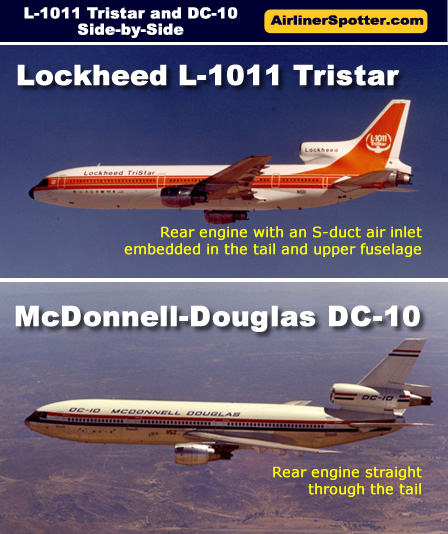
The rival L-1011 TriStar and DC-10 looked alike, but that's where the similarities ended. For starters, the DC-10's third engine was mounted above the fuselage and did not use an S-duct.  [7]
   
As Harrington-Cressman has noted, “The L-1011 and DC-10 followed the same basic brief, but the engineering methods for each aircraft were extremely different. McDonnell Douglas tended to be more conservative in its approach to building its first wide-body aircraft – in many ways, the DC-10 was simply DC-8 technology that was enlarged and modernized in certain respects. Lockheed, on the other hand, felt that the key to success in the market was to take the most advanced technology of the day and when that technology was lacking, Lockheed created it.” [2]

Lockheed's vision and fearless attitude toward research and development was shared by Bristol Aerospace Limited in Winnipeg, which was contracted in 1968 to produce the TriStar’s S-duct. Delivery of 350 units was due to begin in May 1970 and production was expected to last over 10 years.


S-duct assembly area, Bristol Aerospace Limited, Winnipeg  [8]
   
The contract was an important one for Bristol, and required careful planning. A project team of key leaders from several departments was established early in 1969, and preparations included new facilities and a plant expansion to handle the work. Bristol had a technical representative at Lockheed’s plant in California who could expedite technical decisions and provide on-site liaison.


In June of 1969 Dad and others from Bristol spent a week meeting with Lockheed's engineers in Burbank, California.

Dad was always proud of the S-duct job, and always wore an L-1011 tie clip on his Fraser tartan tie, along with his Lancaster bomber and gold Bristol Aerospace lapel pins.

Clare Geddes and his friend Murray Fraser

Bristol's L-1011 S-duct on display  [8]
   
Bristol’s approach echoed Lockheed’s attitude: “when that technology was lacking, [they] created it.” The S-duct program required advanced technical expertise and engineering methods. Each S-duct was built of aluminum and titanium alloys, and welded stainless steel. Weighing close to 1,200 pounds, each duct was almost 30 feet long, with a diameter of 7 feet, 1 inch. This size demanded new tooling and machining equipment, as well as new technologies in the forming, welding, and assembly of large components, and the increased use of titanium alloys.

The production of the S-duct “introduced to Bristol ‘clean room’ environmental techniques, along with special material testing, and shelf life control, as well as a complex materials procurement schedule and quantity plan for each batch run.” [8]

Special tooling and rigs were required in 1971 for the sound attenuation bonded honeycomb structure, and Bristol staff were trained in new techniques. A more sophisticated sound attenuation was redesigned for the duct-to-engine segment of the S-duct in 1978, when more powerful engines were used in the long-range version of the L-1011.

Bristol’s plant expansion and specialized equipment required a capital outlay of close to $750,000.


First shipment by road, Bristol Aerospace Limited  [8]
   
Bristol shipped an initial large segment of the S-duct to Lockheed in March, 1970, ahead of the May schedule. Lockheed was very pleased and assured of Bristol’s ability to meet its critical requirements.


Bristol proved contract administrator Jim Richardson's claim that, "If it can be made -- we can make it."
Winnipeg Free Press, May 13, 1970  [9]
   
Shipping the S-ducts by rail would be the most economical choice, and would take about five days for the 2200 miles from Winnipeg to Lockheed’s plant in Palmdale, California. But Lockheed wanted shipments by truck as an alternative. This required a specially outfitted transport trailer that was used several times.

The development of the Lockheed L-1011 TriStar is a tale of engineering innovation and vision. Alas, the story of the TriStar versus the DC-10 is as much “a prime example of market saturation and what ultimately led to the undoing of both companies commercially.” [2] The two competitors, Lockheed and McDonnell Douglas, learned the hard way that “great design, engineering, and business go hand-in-hand.” [5]


American Airlines chose the DC-10 over the L-1011, which hurt Lockheed financially, and reduced the number of TriStars built to a mere 250. Production was shut down in 1984.

At the same time, though, McDonnell Douglas’ rushed DC-10 was not a total triumph. The airliner was racked with problems, and earned a reputation as unsafe. [9] Crashes killed hundreds, and design and maintenance were often at fault. Trouble with a cargo door latch, for instance, was a known flaw that was not corrected until it led to two serious crashes.

DC-10s were grounded by the FAA for 37 days in the summer of 1979 following the May 25 crash of American Airlines Flight 191 out of Chicago when an engine fell from a wing. That crash killed 273 people and remains the deadliest aviation accident in the United States.


Over the years, DC-10 technical faults were remedied, new long-range variants and an improved version of the DC-10 (the MD-11) were introduced, and faith was restored. The DC-10 eventually became a popular workhorse.

However, tri-engine airliners were ultimately replaced with new planes with more powerful engines, like the Airbus, and the three-engine configuration became outmoded.

Passenger flights on DC-10s ended in 2014. Remaining DC-10s are still in use for hauling freight, mainly by FedEx.

The initial trouble with DC-10s and its poor reputation hurt McDonnell Douglas financially, as did lawsuits from crash victims’ families. In 1997 the company was purchased by Boeing Co., the world’s largest commercial aircraft maker, for $13.3 billion in stock. Boeing phased out production of the MD-11, preferring to focus on their 777 jetliner.

TriStars were withdrawn from service in the late 1990s in favour of the new Boeing 767s and Airbus models. The RAF used L-1011s in military tanker and passenger/cargo capacities until March, 2014.

The last commercial TriStar flight was operated by ATA Airlines, a small regional carrier in Iran, on January 7, 2019.

Currently, one L-1011 remains flying. Operated by Orbital Sciences and called Stargazer, its most recent flight was in October, 2019 to launch Pegasus rockets into orbit around the Earth.


Sources

[1]   Wikipedia, “Lockheed L-1011 TriStar”
https://en.wikipedia.org/wiki/Lockheed_L-1011_TriStar
photo:  https://en.wikipedia.org/wiki/Lockheed_L-1011_TriStar#/media/File:Lockheed_L-1011-1_TriStar,_Lockheed_JP5893645.jpg

[2]   Peter J.M. Harrington-Cressman, “Requiem for a Trijet Masterpiece – the Lockheed L-1011” (September 30, 2015)
http://www.airlinereporter.com/2015/09/requiem-trijet-masterpiece-lockheed-l-1011.tristar

[3]    Lockheed's L-1011 theme song, c. 1970 on YouTube
https://www.youtube.com/watch?v=CxRW-P3kvF4 

[4]   “L-1011 Tristar – too advanced for us” (September 19, 2018) YouTube video
https://www.youtube.com/watch?v=dAjezUfdBXE

[5]   “This Plane Could Even Land Itself: Why Did The L-1011 Fail?” (October 24, 2017) YouTube video
https://www.youtube.com/watch?v=jkFYD7R_Xig

[6]   L-1011 Rolls-Royce RB211 engine, photo for sale on eBay (retrieved January 10, 2020)
https://www.ebay.com/itm/ROLLS-ROYCE-RB-211-ENGINE-LARGE-ORIGINAL-VINTAGE-PHOTO-LOCKHEED-TRISTAR-L-1011-2/193131716162?hash=item2cf78c1e42:g:nOEAAOSwzHBdh7Hv

[7]   L-1011 compared to DC-10
https://www.airlinerspotter.com/mcdonnell-douglas-dc10-md10-md11-spotting-guide.htm

[8]   50 Years of Technology 1930-1980, Volume Two: The Second Quarter Century, Bristol Aerospace Limited, pp. 52-55

[9]  Winnipeg Free Press, May 13, 1970, p. 84

[10]   “What Happened to the McDonnell Douglas DC-10?” (May 23, 2017) http://www.wheresmychampagne.com/mcdonnelldouglasdc-10

[11]   “How This Plane Earned A Dangerous Reputation: The DC-10 Story” (September 28, 2018) YouTube video
https://www.youtube.com/watch?v=l-085TjhUPo


Monday, August 12, 2019

Department 623

Dad began his career at MacDonald Bros. Aircraft on March 8, 1948 as a sheet metal fitter. In February 1952 he progressed to a tool and die maker and then to a chargehand position.


This June 1955 listing for department 205 includes chargehand M. R. Fraser and staff of 29.
   
The company was purchased by the Bristol Aeroplane Company Ltd. in 1954. In August, 1960 Dad was promoted to an Engineering Assistant and transferred to the Planning Department. Within three years he was a Senior Manufacturing Planner, and was a Manufacturing Engineer in the Manufacturing Projects Planning department (623) when he retired in June, 1982.

Work at Bristol Aerospace Limited (its name as of 1965) became increasingly complex and sophisticated. New manufacturing processes demanded a highly skilled workforce, and recruitment efforts became a constant. The company never hesitated to send key employees elsewhere (often the U.S. or U.K.) for specialized training. Partnerships with academic institutions were established, and in-house training allowed employees to advance their skills. Dad was one of their home-grown instructors.
    
Murray Auld joined MacDonald Brothers Ltd. in 1942 as an aircraft inspector for the RCAF. As a Mechanical Engineer, he was well qualified to lead the company into the space age. He was President of Bristol Aerospace from 1967 to 1981, when he retired.


July 15, 1980. The Manufacturing Engineering division included several departments.
Three of them were managed by Dad's good friend, Bill Habington.

c. 1960. GE turbojet engine J79 transition duct.
L-R: Bob Thickett, Larry Hayman, Brownie Stevens, Bill Habington, Henry Wiebe, German Reuther.
Bristol was contracted by Orenda Engines for several components of the engine for the Lockheed Starfighter. "This program provided experience with some of the exotic alloys of the time [...] as well as an introduction to General Electric manufacturing methods and quality requirements. The dedicated efforts of Engineering, Planning, Toolbuild and Production resulted in a very successful program which enhanced Bristol's reputation as a leading manufacturer of engine components." (
50 Years of Technology, vol. 2, p. 127)

   
Bill Habington shared Dad's wicked sense of humour, no doubt welcome in a stressful and demanding department. Habington joined MacDonald Brothers Aircraft Limited in 1962 and was a manager in Department 623 until his retirement in 1986. He passed away on January 25, 1997.
 
The Manufacturing Engineering sector, July 15, 1980.

   
A junior planner in Dept. 623 was Harry Szkwarek, a 1971 graduate of Red River Community College's two-year Mechanical Engineering program. He joined Bristol Aerospace in November, 1973. Harry felt he owed a lot to Dad, and appreciated his mentorship. He posted a nice tribute to Dad's online obituary, identifying himself as a "friend" rather than as a "co-worker":
  • I had the privilege of working with Murray at Bristol Aerospace from 1978 till the time of his retirement. As a young / green Engineering technologist starting with Bristol Murray became my mentor and helped me develop my trade as a manufacturing planner by sharing his wealth of experience. He was a person who was patient and respectful with anyone he was dealing with and was well respected by his working colleagues. Thru the working years Murray and I became good friends and shared our common factor of being parents of twins and continued to be friends during his retirement years whenever there was an opportunity and at functions, other Bristol retirements and occasional meetings in malls etc. If there was a person on this earth who should still be with us Murray was that person because he touched many people with his happy disposition on life, his many stories, and willingness to help anyone who would ask. I am thankful for having the privilege of knowing Murray and will miss him and my sympathy goes to the Fraser family for their loss. 
              -- Posted by: Harry Szkwarek (friend) on: May 01, 2013
L-R: Bill Milne, Murray Fraser, Harry Szkwarek, Stewart Janke
    
c. 1979. Bristol earned a solid reputation for its manufacture of turbine engine components. This exhaust frame was part of a GE F404 engine used in McDonnell Douglas F18 jet fighters.
L-R: W. Green, D. Wiebe, P. Verbeek, M. Fraser, E. Wall, J. Kurk. In front: K. Urich.

L-R: Bob Power, Jack Sears, Bill Milne, Stewart Janke, Murray Fraser, Frank Reardon

Harry Szwarek was grateful to have learned so much from Murray Fraser. The job of planner was not an easy one, and the stakes were high. The job description was a daunting nine pages long. Dad's copy below is likely from 1963, when he was promoted to Senior Manufacturing Planner.


In September, 1973 Bristol Aerospace Limited introduced a Salary Administration Plan for salaried staff like Dad. The plan's intent was "to ensure that salary Bristol Aerospace staff are paid on a fair and consistent basis" and its objective was "to recognize the contribution of each individual/position to the corporate objective." It was hoped that by maintaining equity and relating salaries to the local and national employment market, the Plan would "recognize an individual employee's growth in his position, exceptional performance, and the potential for greater responsibility in progressively senior positions."

The Plan's evaluation process included a questionnaire, interview, and preparation of a position summary. An internal comparison with other positions within the Company examined scope and impact, knowledge and skills, and difficulty and complexity. The position summaries would be reviewed annually to keep descriptions and salary ranges up-to-date.

Dad received the questionnaire in July, 1973, and answered as follows.

A     DESCRIBE THE SCOPE AND IMPACT OF YOUR POSITION:

1)  Identify by position title the people you supervise (directly on a full-time basis and on a work-assignment basis). Describe the purpose of each position and their contribution to the activities of the company.
Usually none, although a Senior Production Planner may have one or more junior planners assigned to assist him through the more active phase of a new job.

2)  How many people do you supervise through subordinates?
None in the usual manner, but a great many people are directed by a Planner through the media of prime planning instructor sheets -- Production Order Cards, Tool Fabrication Orders, etc.

3)  In what ways do you influence policy, objectives, programs or operations? (Provide 1-3 current examples.)
A Senior Planner is often consulted very early in a program; e.g. G.E. Lynn may send in drawings of small jet engine parts with a request for quotation. Our contracts people consult our Production Engineering and Manufacturing Planning supervisors for an appraisal of our capabilities to manufacture the parts. The planner assists in the preliminary decision -- to bid or not to bid -- by studying the supplied drawings and specifications, and reporting on such things as equipment and process capabilities and additional requirements.
     A planner's major work, of course, begins when a bid to manufacture has been accepted, and the objective is to produce and deliver to schedule has been committed.
     The L1011 'S' duct is an example of a current sophisticated aircraft structure planned and manufactured at Bristol, Winnipeg.
     Another example of planning service to top management decision makers was a Manufacturing Feasibility Report on stator vanes for G.E. jet engines -- a high quantity, high precision type of detail. Our study indicated a capital equipment requirement of approximately $920,000 for one size vane only! Changes in vane design, e.g., to a vented precision casting, or political pressures, could have left us with a million dollar 'white elephant'. Our management wisely decided not to venture into this highly specialized branch of manufacturing activity.

4)  What financial responsibilities do you have for the operations within your department and what decisions do you make that affect the financial position of the company?
Decisions made by the Planning Department -- Tooling and Manufacturing Methodology, have profound effect on the efficiency of relevant manufacturing operations and the veritable profit or loss of the corporate venture. "Bottom line consciousness" is not the concern of the accounting department alone.
     Tool expenditure should be kept within the estimated budget, but total part quantity, required production rate, and quality control are all factors the planner must evaluate in selecting the optimum tool design parameters.

5)  Describe the authority you have to act independently in the various aspects of your position (e.g. technical, supervisory, or managerial or administrative).
The individual planner is expected to direct the technical -- tool design and production methods, managerial and administrative -- preparation of Tool Fabrication Orders, Production Orders, associated documentation logical progress and sequence to meet or better the schedule requirements of a program, with the concurrence and guidance of Planning and Engineering supervisors.

6)  What possibilities exist for error in your position and what are the specific consequences of error?
There are many possibilities for planning error, e.g. an error of calculation, whether of typographical or judgment origin, on a Production Order could result in the manufacture of scrap parts. If the scrapped material is titanium, high nickel alloy, or other 'exotics' commonly used at Bristol, the value in material loss, plus the labor invested, could reach a shocking figure. A more serious result of such loss could be the delay of sub and prime contract commitments, pending replacement of material and labor.
     The specific consequences of errors, in addition to the above, could be a request that the planner take his talent(?) in hand and seek his fortune elsewhere.

7)  Give examples of typical decisions that are made in your position. List in order of importance.
Typical decisions made by a manufacturing planner, in order of importance:
a.)  The selection of tools for a new manufacturing program. "Make or buy" decisions.
b.)  The selection of plant equipment to be utilized -- (existing or additional).
c.)  The direction of sequencing, (PERT -- Program Evaluation and Review Technique basics) to ensure that the delivery schedule is met. Coordination of tool issue and priority, Experimental and Development work, Prototyping proving of details and assemblies, alternate "back to the drawing board" schemes, shop liaison to "make it work."

8)  Describe your major internal and external contacts with individuals, organizations, etc.
A planner is occasionally sent by Bristol management on trips to other firms such as General Electric, De Havilland, Boeing, Lockheed, Edo, or Rolls-Royce for technical liaison. A planner may also meet with people from such 'primes', whether resident (e.g. Quality Assurance) or visiting -- Management Engineering or Contracts representatives.
     More commonly, a planner must cooperate with his supervisor, Contracts, Engineering, Estimating, Production Control, Stores, Tool Build, and Production shop people in his day-to-day routine.

B     WHAT KNOWLEDGE AND SKILLS ARE REQUIRED TO EFFECTIVELY CARRY OUT YOUR RESPONSIBILITIES?

1)  What formal education and training would a replacement in your position require today?
An aspiring Senior Manufacturing Planner should have a minimum of Senior Matriculation academic achievement, with a good record in Mathematics, Chemistry, Physics and English subjects. Education as an Engineering Technologist would be a desirable asset, as would experience elsewhere as a manufacturing planner in the Aerospace Industry. Training or experience in the related shop skills -- sheet metal work, machining, welding, chemical treatments, plastic, cement and paint work is very desirable.

2)  Define the 'know how' that should have been acquired through experience by a replacement in your position, i.e. technical knowledge; occupational knowledge; management skills; knowledge of this industry or company.
In addition to the above background, he must be trained in the specifics of Bristol Wpg. operational procedures and equipment, and in the particular specifications of the "majors" (e.g. Lockheed) drawings, processes, quality assurance requirements, etc., with which he maybe involved.

3)  What abilities are important to achieving results in your position, e.g. the ability to communicate, to motivate others, to persuade, to analyze, to create new ideas or concepts, to make judgments, etc.
The constantly changing technology of the 'avant garde' aerospace industry requires the ability and desire to keep pace with new developments, the intelligence to select or design the optimum tools and methods. Consideration must be given to the quality, tolerances, and delivery (first off commitment, max rate, total quantity) requirements of the manufacturing project. The planner must coordinate the effort, skill and ability of many people involved in a project, to maintain the Bristol reputation of high quality products delivered on schedule.

C     DESCRIBE THE DIFFICULTY AND COMPLEXITY OF YOUR POSITION

1)  What type of planning is involved in your position, e.g. is planning of a short term or long term nature? Do you determine schedules for courses of action to be taken? Is planning you do based largely facts established by research or on your own judgment, and how significant are unknown factors in your planning?
See reply to question A 7) for a brief outline of the type of manufacturing planning operations required at Bristol.
     Planning methodology must conform to the requirements of the drawing, and associated specifications, processes, and treatments. Such mandatory methods may have been established by research and development departments of the 'Prime' contractor. For example, Lockheed's specifications for fabricating titanium alloy provide us with guidelines for the forming, heat treating, machining, welding, etc., of this difficult to work with 'space age' metal.

2)  Are you involved in the creation of new concepts, or in the development of new applications for established concepts? (Give examples)
Notwithstanding the information provided by Lockheed on fabrication of titanium, problems have arisen which required a local solution, e.g. new concepts in welding technology -- special joint preparation to eliminate excess porosity in T.I.G. welds; mechanical cleaning before welding, in lieu of prohibitively expensive and hazardous nitric-hydrofluoric acid tank dipping; new techniques in hot sizing large titanium parts in existing stress relieving furnace.
     Another example of a new planning concept was the improved method and new dies designed and developed for the production of the swirl cup (J85 annular combustion liner), resulting in a unit standard time 1/25 of the 'old' method.

3)  What kind of pressures and disruptions do you experience?
It is part of the responsibility of a planner to 'aid and succour' to the best of his ability, all and sundry who come to him for advice and assistance. Demands on a planner's time are unfortunately heaviest during the 'heat' of a project, when he has the greatest work load at his own desk. The impending delivery date is a pressure on all concerned with a project, and progress analysis, reports, and meetings provide continuing interruptions. Necessary consultation with engineering, tool design, contracts, production control, estimating, quality control, scheduling, tool build, test lab, inspection, and various shop people demand considerable planning time.
     Recorded checks of 'unsolicited' interruptions (June 8/67 and Dec. 11/69) revealed an average interference in this planner's routine every 11 or 12 minutes -- often enough to make concentration difficult.

4)  Give examples of the major difficulties and problems in your position and the usual methods of solution.
Major difficulties and problems (in addition to the preceding) are the daily routine of a planner. A recent problem concerned the disposition of a quantity of nome honeycomb strip for the L1011 RA519. The strip had been ordered to the neat proven width of 1 1/8 + 1/32 tol. Hexcel, the supplier, offered a unilateral tolerance +1/4~0, which was accepted by Bristol purchasing. The problem was not just how to cut honeycomb to a closer tolerance than the maker could supply, but to accurately remove such a small surplus on this flexible material. Collaboration of planning, tool build and department 211 solved the problem using a special set up of the 'valve stem' rebate cutter.
     Another example of a problem referred to planning concerned the forming of seal retainer, part #1541441 (L1011). The press form die designed and developed for this job produced too high a percentage of malformed parts. Straightening parts after forming, while possible, was too time consuming and costly. Forming study revealed that parts with minimum distortion after heat treat, were formed by the die to the correct contour. The solution then, was to prevent or correct the distortion. The latter, in the form of a roll-straightening operation, proved to be the optimum solution.
     A major difficulty for a planner, facing such a problem as the above seal forming, is to keep his 'cool' and objectivity in the face of disaster and criticism, and select the best 'way out' without panic, bias, or false pride. Sometimes, an honest "painful reappraisal," indicates a scheme should be abandoned and a new 'back to the drawing board' approach taken.

D     SUMMARIZE IN ORDER OF IMPORTANCE THE MAJOR RESPONSIBILITIES OF YOUR POSITION.     

1.)  It is often the responsibility of the planner to study drawings and specifications submitted with a request for quotation, and advise management of new equipment and/or processes that would be required. (See A 3 for further detail.)
2.)  The project planner is responsible for planning the methods to produce quality hardware in time to meet the 'first off' deadline at a production rate to meet or better the projected schedule requirements, and at a cost no greater than that already committed by estimating.
3.) The planner must outline and scheme design the tooling requirements for the project. He must schedule the sequence of tool design and tool build such that tools are available in a logical sequence to suit the part schedule target dates.
4.) The planner must be capable of 'trouble shooting', finding solutions to problems that arise in the development phase of new manufacture, and promptly correcting and improving the methods to keep the job moving.
5.)  The planner is responsible for the 'paperwork', Production Orders, Tool Fabrication Orders, Production Order Amendments, Rejection Rework Orders, Technical Queries, Tooling and Progress Records, etc. The five "C's" of business letter writing -- clear, correct, concise, complete, courteous -- apply to planning communications both written and verbal. Parkinson (of Parkinson's Law) has stated that "the effectiveness of communication is inversely proportional to the length of the message." After consideration of that sobering thought, this would seem a good place to conclude this document.

Question C3 asked "What kind of pressures and disruptions do you experience?"
Dad recorded the unsolicited interruptions he dealt with on June 8/67 and Dec. 11/69, which revealed an average interference every 11 or 12 minutes in what was already a very long (8:20 a.m. to 7:25 p.m.) day.


December 11, 1969. Things hadn't improved two years later.

It seems evident that Dad was considered an expert and people came to him for assistance all too often. No wonder he often worked on Saturday mornings, too, when he could concentrate with fewer disruptions.