Mom was 27, Dad 30, when they married in 1949. The war had interrupted Dad’s career, but by then he had landed a solid job, and the two were ready to settle down and raise a family.
They made up for lost time. The Frasers outpaced the Canadian baby boom of 1952-65, whenthe average number of children per woman was 3.7. (1) By March 5, 1957 Mom and Dad had five children under the age of six, including three in diapers. As twins, Karen and I completed the family.
It's twins! Congratulations rolled in from all corners.
They were probably really thinking, "Yikes, better you than me."
Many might groan at the thought of twins, but Mom took it all in stride. She explained to me that, “One baby takes all of your time, so what’s the difference?” Having twins had its benefits, she claimed; we kept each other occupied while she attended to other kids and chores.
An efficient, practical person, Mom also said, “Two babies in seven months. You can’t do much better than that.”
Phew, "early but safe arrival." I presume I was named after the obstetrician as a gesture of appreciation.
We were seven weeks premature, which is not that unusual. Wikipedia (2) states that, “Multiple pregnancies are much less likely to carry to full term than single births, with twin pregnancies lasting on average 37 weeks, three weeks less than full term.”
Not surprisingly, twins tend to weigh less than single babies, too. I arrived first, at 4:06 a.m., weighing 3 pounds, 14.25 ounces. Karen followed at 4:54 a.m., at a whopping 4 pounds, 3 ounces. (I’ve been a night owl ever since.)
“Two babies in seven months. You can’t do much better than that.”
According to Wikipedia, “More than half of twins are born weighing less than 5.5 pounds (2.5 kg), while the average birth weight of a healthy baby should be around 6–8 pounds (3–4 kg).” Although perfectly healthy, Karen and I did have to stay in the Grace Hospital for several weeks until our weights came up. Cozy incubators are not a bad place to be in a Winnipeg winter. Thankfully, the oxygen incubators were leaky and we were hefty enough to avoid retinopathy (in which retinal blood vessels grow abnormally and can cause blindness), a risk for earlier, smaller preemies.
Home at last, summer of 1957, with Grandma Annie Fraser
Mom knew she was having twins, and it probably wasn't much of a surprise. There is a higher chance of having fraternal twins if there is a family history of such, but there is no genetic link for identical twins. Apparently, her mother had lost a pair of twins between her two youngest children (Ernie and Wes).
Eight months old.
The twins' first birthday, surrounded by diapers. Karen (right) needed haircuts long before I had hair.
Mom was smart to move the wringer washer (left) to the main floor.
Not sure what I'm chewing, but I did not punch in that clown's face.
Bug Out Bob was a gift (behind the candle in the photos above). I found it behind a radiator years later.
Mom designed the storage unit behind the kitchen table, but for small appliances, not diapers!
Fraternal twins are the most common type of twins. Because they arise from two separate eggs fertilized by two separate sperm, fraternal, or dizygotic, twins are essentially siblings who happen to be born together.
Mom was 35 when she had twins, an age when fraternal twinning rates double. Twins are also more likely if the mother is greater than average height and weight, and if she has had several previous pregnancies.
Looks like everyone got pyjamas for Christmas.
L-R: Wally, Myrna, Virginia, Ruth pushing Karen in the box.
Some children get Fisher-Price toys. Frasers push the vacuum around.
Robert Dalton Muir
(August 7, 1926 - 1999)
[Source: Castleguard]
Dalton Muir was born in 1926, a mere seven years after Dad. But it was Dalton’s father (George Muir, 1887-1954) who was one of Dad’s 33 "Reid" cousins. Dalton’s grandmother, Mary (Reid) Muir, was a full 20 years older than Annie (Reid) Fraser, the youngest born to Peter and Christena Reid. Again, Mary McKay’s book, Far Spread the Sparks from Cantire, provides us with a profile of yet another accomplished individual in the Reid family tree.
Dalton Muir, from Far Spread the Sparks from Cantire
Dalton Muir, the only son of George Muir and Leta Dalton, was a staff member of Canadian Wildlife Services, Ottawa, for many years. He travelled widely in the Arctic and the west and was especially known for his wildlife photography.
Born and educated in Toronto, he graduated from North Toronto Collegiate in 1945 and the University of Toronto in 1951. In 1970 he returned to Carleton University and graduated with a Master of Science degree.
His boyhood hobby of photography developed during his high school years into a fascination for capturing on film birds, especially hawks and owls. After graduation he began making science films for the National Film Board and later worked for National Parks – Environment Canada.
While at the University of Toronto he met his future wife. On October 7, 1953 he married Marianne Boyd, daughter of Arthur and Mary (Bomps) Boyd of Toronto. They had two sons: Richard (1956) and Roderick (1959).
The summer before Richard was born Dalton and an assistant, Norval Balch, spent five months on Ellesmere Island, Canada’s most northerly land mass. They made two colour films for the National Film Board Science Film Unit. These were the first such movies made in that bleak land. Dalton and Norval were flown by R.C.A.F. North Star and C-119 Box Car to the weather station at Eureka on Ellesmere Island. From there, they covered their territory by canoe, foot and plane. Being a person who prefers cold weather to hot, Dalton enjoyed the 4 degrees temperature and 24 hours of daylight on Ellesmere Island.
From 1956-1963 the family lived in Beaconsfield, P.Q., and then moved to Nepean, just outside Ottawa and Dalton continued his photography work with the Canadian Wildlife Services. Dalton was invited by the Manitoba Museum of Man and Nature to visit the nest of the Great Gray Owl that had been sighted south and east of Winnipeg. Within a few days of completing his studies at Carleton University, Dalton left Ottawa by car and drove to Winnipeg. There he met Herb Copland who worked with him in the days ahead. At the nest site, working quietly, slowly and carefully, they erected a tower blind just nine feet from the sitting bird without once causing her to leave. She quickly accepted their presence and soon paid no attention to their activities. During the next five days Dalton slept in a tent less than a hundred feet away and spent about 18 hours a day in the blind located in a swampy area close to the U.S.–Canada border. They observed the birds’ hunting and feeding habits and caught the first glimpse of the three young birds when they hatched. The opportunity for close observation of this little known owl gave Dalton and his colleagues a unique insight into the lives of a family of birds of primitive instincts and stereotyped behaviour.
Dalton recorded several of his interesting adventures in Nature Canada, Canada’s nature magazine.
Arctic and other glaciated landscapes have been a lifelong concern of Dalton’s. In 1985 he and Derek Ford took pictures of Castleguard Mountain in British Columbia. Dalton did the photography of the above ground terrain and Derek photographed the miles of caves. Their work was published for National Parks Centennial in a book called Castleguard.
Castleguard, published in 1985
Dalton retired in 1988 and enjoys carpentry, metal work, electronics and landscaping. He enjoys skiing in winter and he and Marianne have travelled in their van, coast to coast and into the Arctic wilderness. He likes to go places no one else has ever been. They have visited Wales, Scotland, Alaska, Labrador, Inuvik and Newfoundland. In the winter of 1992-93 they spent five months travelling from Florida to California and up the west coast.
====
Dalton passed away in 1999, and his wife Marianne died in 2014.
Castleguard remains a legacy. It is a handsome coffee table book that is also an academic study and pictorial record of a unique place in Canada. An introduction on the dust jacket reads as follows:
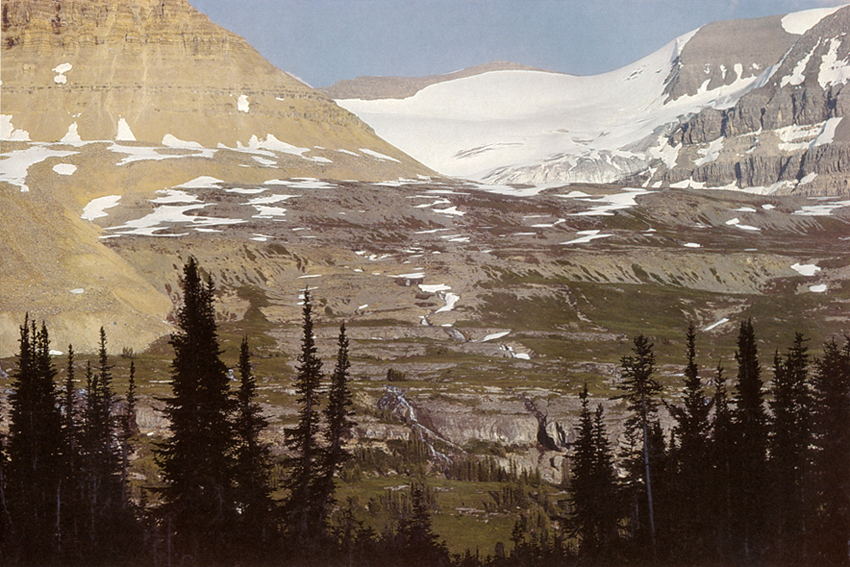
Beside the Columbia Icefield, in Banff National Park, lies a narrow valley. One end of the valley is a barren arctic waste, newly formed by the retreat of the ice ages. Gradually, it grades into an alpine meadow and then into a northern coniferous forest. The valley and the glaciers around it tell the story of how the landscapes of Canada were formed, from the great ice ages to this summer’s flowers.
Partway down the valley there is a cave mouth, the sole entrance to an enormous complex of vaults and passageways that winds for eighteen kilometres under the valley and glacier. In the cold darkness of the Castleguard caves water has been forming and enlarging passages for hundreds of thousands of years. Glistening white stalactites, among the purest in the world, have been growing for millennia.
Come celebrate Castleguard with the adventurers who have explored and photographed the austere beauty of this land shaped by water, cold and time.
Here are a few of Dalton’s photographs and descriptions from Castleguard:
Entrance to an underground landscape (photo 4)
Near the wet rock lies a cave entrance, the only way into a vast and complicated landscape carved out of limestone by water sinking from above. Late each day during hot summer weather, high snow, the icefield and nearby glaciers melt so fast that the natural cave drainage is overwhelmed. Water backfloods, out of the caves below, and pours down the limestone pavement in the foreground. It sometimes washes completely over the huge boulder on the right.
This flooding seals the cave, sometimes for many days. During summer, only the first cavern may be entered safely. The other caverns and passages must be explored during winter months, when there is no danger of flooding.
Sitting in the cool breeze that comes out of the entrance chamber on a hot day, one finds it difficult to imagine what lies beyond. More difficult still is comprehending that the subtle processes visibly changing the surface of the nearby wet rock have carved the miles of cave that lie inside. Perhaps most difficult of all is the long wait for winter when we may enter.
Inside Valley Glacier (photo 9)
Castleguard is bounded on the north side by the Saskatchewan Glacier, which flows from the Columbia Icefield. Along both sides, smaller glaciers join the main ice, like streams emptying into rivers. This tributary glacier had retreated and did not join the main stream when this photo was taken in 1969. In 1984, the tributary glacier had retreated farther, and the Saskatchewan Glacier had sunk noticeably. This is typical of the overall melting and retreat of most glaciers in the Rocky Mountains during the recent decades. The figure of the hiker emphasizes the immensity of the distant ice mass, yet it is trivial compared to the Saskatchewan Glacier underfoot.
Flowers on an Alluvial Fan (photo 31)
High in the mountains, spring arrives late but fall arrives early. During the short summer, plant life develops at breakneck speed and a brief, glorious surge of blossoming appears. Only a few days after the first flowers of a species appear, the rest burst into bloom. Seed follows quickly, because an unusual early frost is always a danger. When early frost strikes, an entire year's seed production may be lost; no new plants will form and continuity of the species will depend on the survival of existing plants. This early August scene shows the entire vertical sequence at the height of summer. At the top are the sterile mountain peaks. Below lies the central Castleguard Glacier, led by the Columbia Icefield, with its light-brown lateral moraine. Among trees of the thin alpine forest is the rocky stream that carries meltwater down to the alluvial fan. The moist, well-vegetated margin of the fan is a floral meadow in full bloom. Two days after the photograph was taken, night-time frost killed the flowers.
This setting is also a dramatic rendering of ecological succession. From barren gravel deposited perhaps a hundred years ago, a series of plant communities has progressed to become a floral meadow of species such as the showy pink legumes of the pea family and the less noticeable cream-coloured Dryas of the rose family.
The Red Spring (photo 105)
This is how a cave begins. Water is pouring from a wide horizontal slot (a bedding plane) but the opening that has been eroded is no more than 2 to 3 cm/1 to 1-1/2 inches high. As hundreds and thousands of years go by the channel will deepen and the slot will become a cave passage several metres wide and deep. The spring has been named "Red Spring," from the distinctive colours of the mosses and algae that grow on the cliff below it. Most springs in this region dry up during the winter, but this one flows throughout the year, dwindling to a litre or two per second, less than one percent of the July flow seen here. The water is coming through a floodwater channel from Castleguard Cave, 150 m/500 feet to the rear of the picture, and it is believed to drain parts of the southern half of Castleguard Meadows.
Time (photo 111)
The experience of Castleguard is a journey through time. The rocks were formed hundreds of millions of years ago. The mountains are younger, pushed up by forces some tens of millions of years ago. The great glaciers passed over them repeatedly within the past few million years and just melted away about ten thousand years ago. The Little Ice Age happened within history, during the past seven hundred years. It ended during this century, within living memory. The meltback continues today. Each year winter passes over the land and changes the details of Castleguard. Late-spring storms delay the onset of growth and summer frost may end the floral display on the Meadows.
At Castleguard, we can read time in the landscape. Beneath all that is visible on the surface lies another landscape, the Cave; it too is a mirror of time.
Castleguard is a perfect embodiment of the National Parks concept: a heritage of important natural landscapes preserved for all time, while making possible recreation, discovery, insight and memories.
Reward (photo 112)
Early adventurers dreamed of streets paved with gold. We have built a civilization that surpasses this crudely imagined luxury. Still, we search, and sometimes find a greater treasure. The sun that burned us through the day had risen behind Terrace Mountain and flooded over the glacier nearby. At sunset it turned the opposite valley wall to gold against a threatening sky. Then, it swept the shadow of another mountain over us, over the trees beyond the stream, the valley, the huge moraines and the high valleys. It lingered briefly on remnant snows and ice that still tear at the mountains before darkening the peak.
Reflection (photo 113)
Most of us live so far from a glacier that it is nothing more than a remote object of curiosity. Yet all of Canada is a glaciated landscape. We obtain food and wood from its soils, live on it and bury each passing generation in it. As we stare past the warm glow of the fire at the sunset on the shrunken glacier across the valley, we can experience this continuum. The small, unnamed glacial remnant on Terrace Mountain, and our near one that is warmed by the rising sun, are realities that confirm our place in the natural order and link us to processes still moulding the face of earth.
====
Dalton Muir brings to mind another environmentalist and photographer in the family, Russell Reid. Russell (1900-1967) was a cousin to Dalton’s father, and was 26 years older than Dalton. Russell certainly shared the same reverence for Nature and interest in national parks that Dalton had, but he lived in North Dakota, far from Dalton’s base in Ontario. Russell passed away a few years before Dalton visited Manitoba to photograph the great gray owl, so I doubt they ever met, which is a tremendous shame. They would have been instant friends. You might also be wondering if Dalton Muir is related to the great John Muir (1838-1914), the naturalist and conservationist regarded as the Father of National Parks in the USA. The Sierra Club website states that Ken Burns, the documentary film maker, considered John Muir to have "ascended to the pantheon of the highest individuals in our country; I’m talking about the level of Abraham Lincoln, and Martin Luther King, and Thomas Jefferson, and Elizabeth Cady Stanton, Jackie Robinson – people who have had a transformational effect on who we are." The Sierra Club website explains John Muir's importance:
"As a wilderness explorer, he is renowned for his exciting adventures in California’s Sierra Nevada, among Alaska’s glaciers, and world wide travels in search of nature’s beauty. As a writer, he taught the people of his time and ours the importance of experiencing and protecting our natural heritage. His writings contributed greatly to the creation of Yosemite, Sequoia, Mount Rainier, Petrified Forest, and Grand Canyon National Parks. Dozens of places are named after John Muir, including the Muir Woods National Monument, the John Muir Trail, Muir College (UCSD), and many schools.
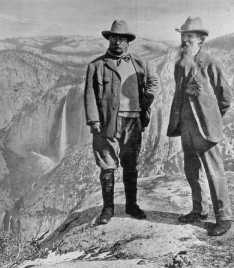
Teddy Roosevelt (left) with John Muir, 1903 (Library of Congress)
"His words and deeds helped inspire President Theodore Roosevelt’s innovative conservation programs, including establishing the first National Monuments by Presidential Proclamation, and Yosemite National Park by congressional action. In 1892, John Muir and other supporters formed the Sierra Club 'to make the mountains glad.' John Muir was the Club’s first president, an office he held until his death in 1914. Muir’s Sierra Club has gone on to help establish a series of new National Parks and a National Wilderness Preservation System."
Dalton Muir and John Muir: if not kin, then kindred spirits. John was born in Dunbar, Scotland, on the coast east of Edinburgh. In 1849 his family moved to Wisconsin, and by 1868 he had settled in California. He does not appear to be related to the Muirs in our family tree, unless there is a distant link back in Scotland. John Muir did, however, spend two years in Meaford, Ontario, which is in Fraser and Reid country. The young Muir worked in a Meaford mill, producing hay rakes and broom handles, from 1864 to 1866. When the mill burned down, John returned to the States. (Some say he was in Canada to avoid service in the American Civil War.) The Meaford Museum still commemorates "John Muir Day" on the 21st of April each year, as does the state of California, in accordance with California Education Code Section 37222.1:
On John Muir Day, all public schools and educational institutions are encouraged to conduct exercises stressing the importance that an ecologically sound natural environment plays in the quality of life for all of us, and emphasizing John Muir’s significant contributions to the fostering of that awareness and the indelible mark he left on the State of California.
Mark your calendars, and raise a wee toast to all the Muirs! ⇧ Back to Top
The most worn-out volume in Pete Fraser’s library was undoubtedly Peck’s Bad Boy and His Pa, first published in 1883. [David Harum of 1898 runs a close second.]
George Wilbur Peck (1840-1916) was an accomplished man. The oldest of three children, he was born in Henderson, New York, but the family moved to Wisconsin three years later. Peck attended school in Whitewater, Wisconsin until age 15, when he began his career in the newspaper industry as an apprentice printer with the Whitewater Register. At age 20, Peck married Francena Rowley and they had two sons.
Lieutenant George W. Peck
[Source: http://georgewpeck.com/gpbio.html] The GeorgeWPeck.com website is comprehensive and worth a look.
In 1863 Peck enlisted in the Union Army, and was taken prisoner in Richmond, Virginia. Upon release he was appointed to West Point Military Academy by Abraham Lincoln. He served as a lieutenant before his regiment was mustered out in 1866. After the war, Peck worked for a number of newpapers. In 1874 he founded The Milwaukee Sun. Within 10 years the weekly paper had an astounding nation-wide circulation of more than 80,000. The Sun included Peck’s sketches featuring a bad boy named Hennery. They were very popular, and in 1883 the stories were collected into a book called Peck’s Bad Boy and His Pa. George Peck soon became a household name. The text is a product of its day, and pokes fun at all corners of society. Some were appalled at Peck’s treatment of Victorian mores, temperance, politics, the church, freemasons, and class distinctions. The book is politically incorrect and often violent, but always hilarious. George Peck introduced the Bad Boy to his readers:
Each chapter typically begins with Hennery, the Bad Boy, entering the local grocery shop. He might be limping or sporting a black eye. He explains to the grocer how his latest punishment is the result of yet another prank pulled on his long-suffering father, George. A chum is often his partner-in-crime. While recounting his latest story, Hennery typically swipes some food from the grocer, who then quietly charges several times the amount to the Peck account. Before he leaves, the Bad Boy moans that a boy can’t have any fun anymore. As he goes out the door, the Bad Boy might put out a sign in front of the grocery. The grocery man learned to check for these:
FRESH LETIS, BEEN PICKED MORE’N A WEEK. TUFFER’N TRIPE.
SPINAGE FOR GREENS, THAT THE CAT HAS MADE A NEST IN OVER SUNDAY.
CASH PAID FOR FAT DOGS.
YELLOW SAND WANTED FOR MAPLE SUGAR.
SMOKED DOG FISH AT HALIBUT PRICES, GOOD ENOUGH FOR COMPANY.
WORMY FIGS FOR PARTIES.
STRAWBERRIES, TWO SHILLINGS A SMELL, AND ONE SMELL IS ENOUGH.
SPOILED CANNED HAM AND TONGUE GOOD ENOUGH FOR CHURCH PICNICS.
and a favorite:
It is easy to imagine Dad chuckling at Hennery’s pranks. Although never taken to task by his own father with a bed slat, Dad admitted to a few Peck-ish pranks of his own:
teasing his dog (tapping on the floor to indicate food that wasn’t there, prompting the poor Collie to bite the floorboards in frustration);
putting cut-up elastics in his sister’s party sandwiches; and
hooking up a car battery to an old sow’s fence, causing the crippled, arthritic animal to sprint for the first time in years.
There are some great phrases in the book that were certain to make Frasers laugh.
As the Bad Boy tells the grocery man:
In the morning he [Father] took me into the basement, and gave me the hardest talking to that I ever had, with a bed slat. I am going to work in a glue factory, where nobody will ever come to see me. … and if it hadn’t been for these pieces of brick [in his britches] he would have hurt my feelings. […] I have a good notion to take some shoemaker’s wax and stick my chum on my back and travel with a circus as a double headed boy from Borneo. A fellow could have more fun, and not get kicked all the time. Well, good day. There’s a Italian got a bear that performs in the street, and I am going to find where he is showing, and feed the bear a cayenne pepper lozenge, and see him clean out the Pollack settlement. Good bye. … and we went home and Pa fanned the dust out of my pants. […] Well, good bye. I am going down to the morgue to have some fun. Say, don’t you want to hire me for a clerk? The grocery man said he had rather have a spotted hyena, and the boy stole a melon and went away. … he made me wear two mouse traps on my ears all the forenoon, and he says he will kill me at sunset. [after being dumped by a girl]: I shall never allow my affections to become entwined about another piece of calico. It unmans me, sir. Henceforth I am a hater of the whole girl race. From this out I shall harbor revenge in my heart, and no girl can cross my path and live. I want to grow up to become a he school ma’am, or a he milliner, or something, where I can grind girls into the dust under the heel of a terrible despotism, and make them sue for mercy. To think that girl, on whom I have lavished my heart’s best love and over thirty cents, in the past two weeks, could let the smell of a goat on my clothes come between us, and break off an acquaintance that seemed to be the forerunner of a happy future, and say “ta-ta” to me, and go off to dancing school with a telegraph messenger boy who wears a sleeping car porter uniform, is too much, and my heart is broken.
[after polluting the house and church with limburger cheese]: I want to board at a hotel, where you can have a bill-of-fare and tooth picks, and billiards, and everything. Well I guess I will go over to the house and stand in the back door and listen to the mocking bird. If you see me come flying out of the alley with my coat tail full of boots you can bet they have discovered the sewer gas.
Illustration by True Williams, 1900 edition
The grocery man to the Bad Boy: Didn’t you hang up that dead gray tom cat by the heels, in front of my store, with the rabbits I had for sale? I didn’t notice it until the minister called me out in front of the store, and pointing to the rabbits, asked what good fat cats were selling for. By crimus, this thing has got to stop. You have got to move out of this ward or I will. Look here, young man, don’t you threaten me, or I will take you by the ear and walk you through green fields, and beside still waters, to the front door, and kick your pistol pocket clear around so you can wear it for a watch pocket in your vest. No boy can frighten me by crimus.
George Peck’s books were illustrated by the best cartoonists of the day. The first edition (1883) was illustrated by Gean Smith (1851-1928). He was actually known as a great painter of horses, and his paintings still come up on art auction sites.
Cover of First Edition (1883), illustrated by Gean Smith
True Williams (1839-1897) illustrated other Bad Boy books in the 1890s and later. He is better known for his illustrations of The Adventures of Tom Sawyer (1876). While his style is simpler, I find his drawings funnier than those of Gean Smith.
The Bad Boy loses his job at a drugstore.
Illustration by True Williams, 1900.
“… this morning I borrowed Pa’s teeth before he got up, to see if we couldn’t fix them in the dog’s mouth, so he could eat better. Pa says it is evidence of a kind heart for a boy to be good to dumb animals, but it is a darned mean dog that will go back on a friend. We tied the teeth in the dog’s mouth with a string that went around his upper jaw, and another around his under jaw, and you’d a dide to see how funny he looked when he laffed. He looked just like Pa when he tried to smile so as to get me to come up to him so he can lick me. The dog pawed his mouth a spell to get the teeth out, and then we gave him a bone with some meat on, and he began to gnaw the bone, and the teeth come off the plate, and he thought it was pieces of the bone, and he swallowed the teeth.”
Sadly, True Williams was an alcoholic who died in Chicago in 1897 at age 58 of an aortic aneurysm. Other books in the series were illustrated by artists George Frick (listed as “C. Frick” in The Grocery Man and Peck’s Bad Boy, 1883) and Louis F. Braunhold (Peck’s Bad Boy With the Circus, 1905). Braunhold was known for his detailed Civil War etchings. The best-known illustrator of Peck’s books, however, was likely Charles Lederer.
Self-portrait by Charles Lederer
[Source: Wikimedia]
Charles Lederer illustrated Peck’s Bad Boy in an Airship (1908). One of the most brilliant newspaper cartoonists and caricaturists of his day, he was associated with the Chicago Herald for many years. Lederer was the highest paid newspaper artist in the country, and was a writer himself. He published the well-known Lederer Art Course, “A Complete, Simplified System of Drawing, Design, Cartooning and Colour Work” that was advertised nationally. Lederer died in 1925 at the age of 68.
Illustration by Charles Lederer, from Peck's Bad Boy in an Airship, 1908
Peck’s Bad Boy and His Pa was first published in March 1883 and originally sold for $1.00. It was an immediate success. Within six weeks of publication, 200,000 copies were sold.
Several editions followed, and multiple publishers produced subsequent works by George Peck, including The Grocery Man and Peck’s Bad Boy (1883), Peck’s Bad Boy Abroad (1905), The Adventures of Peck’s Bad Boy (1906), Peck’s Bad Boy with the Circus (1906), Peck’s Bad Boy with the Cowboys (1907), and Peck’s Bad Boy in an Airship (1908).
Comedy troupes in the 1890s adapted the stories to the stage, and the Bad Boy went on to movies, board games, comic books, magic lantern slides, and the theatres.
A 1921 movie starred Jackie Coogan (a year after starring in Chaplin’s The Kid).
A 1934 movie starred Jackie Cooper, and another film was made in 1938. Viewers expecting the wit of George W. Peck will be disappointed; these stories are only loosely based on the Peck franchise, and bare little resemblance to the original sketches. The Bad Boy isn’t even bad.
The humourist George Wilbur Peck, looking humourless.
[Source: Wikipedia]
George Peck was a popular politician in addition to being a publisher and author. In 1890 he was elected mayor of Milwaukee, and was governor of Wisconsin in 1894. He retired from public life after being defeated for a third term as governor. Peck reestablished The Sun in 1899, but folded operations a year later, blaming cheaper magazines and daily papers. He turned his attention to writing more Bad Boy books.
Peck was also a businessman and real estate entrepreneur. As president of the San Pedro Rubber Plantation Company of Milwaukee, he planned to develop rubber production in Mexico. In 1911 he became treasurer of Independence Life of America.
He died at age 75 in 1916 of Bright’s (kidney) disease.
Civil war veteran, publisher, author, freemason, mayor, governor, entrepreneur. As accomplished as he was, George Peck will always be best known for Peck’s Bad Boy.
= = = = =
The book remains a popular read and is an interesting study in American literature of the age. Access the full, illustrated text of Peck’s Bad Boy and His Pa at any of these links: