You're not alone. Gremlins have a long history in the air force. They are mentioned in RAF accounts dating back to WWI, and exist in folklore before then.
 |
| Gremlins pester a spitfire. [Source A] |
 |
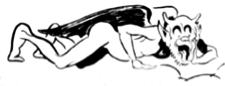
| Wings magazine illustrated several types of gremlins. [C] |
 |
| Gremlins could be Looney Tunes cute, creepy, or downright repulsive. [E] |
As stories spread among military units, the varieties of gremlins expanded exponentially. In a 1943 story in the Philadelphia Inquirer, journalist Chester R. Hope reviewed the variants as follows: “Jockeys” were able to sit cross-legged between the wings of a wayward seagull or pigeon and guide the bird into the windscreen of a fighter plane in flight. “Cavity types” had shovel-shaped noses that they used to dig runway holes in the paths of fighters or bombers coming in for landings, while “Incisors” chewed mercilessly on strut wires. “Puffs” used their big stomachs to suck air out from under wings, causing turbulence just as gunners took aim at their targets, spoiling their shots; similarly, “Optics” loved to hide in bomb sights, turning on the optic glow of their red or green eyes just as a bombardier was lining up his sights on a target. Above 10,000 feet, “Strato-gremlins” took over for the others. The members of this genus, Hope wrote, were “lined inside and out with fur in such a frosty blue tint that it creates virtual invisibility, and they carry oxygen tanks on their backs.”Gremlins plagued all air forces, but reports were especially prolific among WWII Royal Air Force units, especially among the high-altitude Photographic Reconnaissance Units (PRUs) that flew Spitfires and Mosquitoes over enemy territory.
The Royal Air Force Journal of April 18, 1942 [F] published a light-hearted article entitled "The Gremlin Question" that stated that gremlins are encountered in the flying history of nearly every RAF pilot. The story included the following poem:
When you're seven miles up in the heavens,
(That's a hell of a lonely spot)
And it's fifty degrees below zero
Which isn't exactly hot.
When you're frozen blue like your Spitfire
And you're scared a Mosquito pink,
When you're thousands of miles from nowhere
And there's nothing below but the drink
It's then you will see the Gremlins,
Green and gamboge and gold,
Male and female and neuter
Gremlins both young and old.
It's no good trying to dodge them,
The lessons you learned on the Link
Won't help you evade a Gremlin,
Though you boost and you dive and you fink.
White ones will wiggle your wingtips,
Male ones will muddle your maps,
Green ones will guzzle your Glycol,
Females will flutter your flaps.
Pink ones will perch on your perspex,
And dance pirouettes on your prop;
There's a spherical, middle-aged Gremlin
Who'll spin on your stick like a top.
They'll freeze up your camera shutters,
They'll bite through your aileron wires,
They'll bend and they'll break and they'll batter,
They'll insert toasting forks in your tyres.
That's the tale of the Gremlins,
Told by the P.R.U.,
(P)retty (R)uddy (U)nlikely to many
But fact, none the less, to the few.
Gremlin stories abound and became common lore for airmen everywhere, but especially during WWII. Some swore they were real. No doubt the high altitudes, thin air, stress, fatigue, and amphetamines (called "wakey-wakey" or "go" pills) used by airmen [G] account for the prevalence of gremlin sightings. However, some historians explain that blaming gremlins was preferred over criticizing other crew members, because team morale was crucial in the stress of wartime.
 |
| Ice gremlins were especially wicked in high altitudes. [H] |
 |
| Safety campaigns featured gremlins. [I, J] |
Keeping a wary lookout for gremlins [K] was noted in Tee Emm in October 1943.
AN ADJUTANT'S WARNING

At night, my son, I pray take care;
And ere you leave the flarepath's glow
Recite this charm before you go:
Keep out of clouds, watch out for ice,
Mark well the circuit as you dice;
Rely implicitly, O tyro*,
Upon the reading of your gyro.
Remember this and other lore
Drummed into your head before;
Apply with care all 'gen' you know,
Land her safe, then taxy slow.
Guard your precious life, my son,
For once the damage has been done
Your worry is o'er: You leave life's clangour --
But my work starts from there, O Pranger!
* Small, immature Gremlins, usually born out of wedlock, found almost exclusively in the North of Scotland.
-- * -- * --

Nose Art, Squadron 426 [L]
 |
| Mascot and good luck charm of the 482nd Bomb Group. He rode along on bombing missions with the crew. [M] |
 |
| Walt Disney and RAF Flight Lieutenant Roald Dahl explored the gremlin idea. [N] |
Life devoted three and a half pages to gremlins in their November 16, 1942 issue. The article explained that the pixies are only visible to airmen. Although they look cute, gremlins wreak havoc for fliers in many different ways, as the article explained and illustrated (below):
 |
| Life magazine, November 16, 1942 [P] |
 |
| "Sometimes gremlins gang up to do a complicated job. This trio is after the nose gunner of a bomber. One is knocking the machine-gun sight out of line. Another is chiseling at the edge of the glass so cold drafts will get in. Gremlin at the top wears typical bemused look of gremlin thinking up something really good to do." |
 |
| "A gremlin's happiest moments are spent dancing in the slipstream of a wide and comfortable transport wing. Gremlins work only on combat planes and those here are simply hitching a ride to their destination. With no jobs to do, they can relax. Some cavort while others lie down and think poetic thoughts. They hang from ailerons, jiggling them to unbalance the plane. They bore holes in the skin. They damage the rubber de-icing boot on leading edge of wing so that the wing will ice up." |
 |
| "Tickling the navigator is done only at a crucial moment. This navigator with the distressed look on his face is being tickled while trying to steady himself to take a celestial sight. Instrument boards (as at left) make fine playgrounds for the gremlins. They like to seesaw on the artificial horizon and make a merry-go-round of the gyroscopic compass." |
 |
| "Young gremlins are called widgets. This is a sextet of widgets learning their way around a training plane, which, of course, is used not only for training pilots but also for training gremlins. All young pixies must learn the complex rigmarole of plane control mechanism in order to raise hob with it. Widget at the top is pulling out some wiring. One at bottom, still teething, is chewing on a control cable. He will later learn other ways of fraying the strands. Others are testing and probing except for the dull widget (top right) who has fallen asleep." |
 |
| "Kidding the pilot is important. This oaf is making noises that sound like a sputtering motor. The pilot looks worried. Another stunt is to say: 'You're flying upside down, you idiot!' The pilot promptly turns the plane over, really flies upside down. Gremlins consider this great stuff." |
 |
| "Usually gremlins work alone. This gremlin was invited inside by front gunner of a British patrol bomber who, like all fliers, is very cordial to gremlins. But, like all gremlins, this one has no sense of gratitude, repays the hospitality by doing a job on the front gunner's rear." |
-- * -- * --
Lindbergh related what happened to him during the most critical period of the crossing—the 21st and 22nd hour just before dawn, when he had been without sleep for nearly 48 hours. “The fuselage behind me becomes filled with ghostly presences…transparent, moving, riding weightless in the plane,” Lindbergh wrote. “I feel no surprise.…Without turning my head, I see them…clearly.”
He goes on: “These phantoms speak with human voices—friendly, vapor-like shapes, able to vanish or appear at will, to pass in and out through the walls of the fuselage as though no walls were there.” [A]
Magazine articles, cartoons, and Dahl's kids' book popularized the gremlin phenomenon. Stories about them did not disappear after the end of the war in 1945. A horror movie was produced in 1984 called, what else, Gremlins, and a sequel followed in 1990. In 1998 the fuzzy Furby electronic toy was the must-have Christmas toy. Millions have been sold, and several versions have been introduced since then, including "Gizmo" from the Gremlins movie, and Star Wars versions.
To baby boomers, though, the word "gremlins" conjures up a 1963 episode of The Twilight Zone entitled "Nightmare at 20,000 Feet." The episode, starring William Shatner, first aired on October 11, 1963, in the TV show's fifth season. [Q] Perhaps a 16-year-old Steven Spielberg was watching; he included the story in his Twilight Zone: the Movie of 1983. A more hysterical John Lithgow was tormented by a slimy, uglier gremlin. [R]
As Ace Ventura, Jim Carrey paid tribute to Shatner as only he can [S]:
Likewise, the Simpsons tipped their hat to The Twilight Zone in an episode entitled, "Terror at 5-1/2 Feet" in which a gremlin starts to dismantle Bart's schoolbus.
Trenton Air Force Base was no exception to the plague of wartime gremlins. A story [T] by Stan Helleur in their Contact publication of November 1942 quotes an artist who insists he knows what a gremlin looks like. Excerpts from Aircraftman Helleur's story are copied below:

"Contact" presents the first Canadian version of the flying pixies, with LAC. Norm Loranger of Vancouver as our authority.
If I had seen a Gremlin I was to be considered a privileged character according to Loranger, for, as he explained "They normally do not make themselves visible to anyone with less than 100 hours logged."
"Gremlins," he continued, "are of the species Genus Yehudi Ubiquitous, first discovered in India (1923-27) by fliers of the Royal Air Force. One was once seen emerging from a bottle of Fremlin beer, Fremlin being the beer supplied the R.A.F. in India, and the flier, assuming they all came from Fremlin bottles, called them Gremlins . . . Goblin-Fremlin-Gremlin . . . Get it?

"At their prime of life, the males are known as just Gremlins but when they become old and bearded they are called 'Spandules.' Females are known as 'Finellas' while young Gremlins are called 'Widgets.' These drawings I have here," he pointed to those appearing with the story, "are the McCoy as far as their physical appearance is concerned. All other Gremlins I have seen have been sad-looking little guys. As I know them, Gremlins invariably have red cheeks and large noses, though some female Gremlins are quite pretty. They seem to get a tremendous kick out of life consequently always have big grins on their faces. The Air Force version of the Gremlin's size is 'knee-high to a tail-gunner,' but recent evidence would indicate they are really quite small, the average adult being around 5-1/2" tall . . . but then again some are strapping six-inchers.
"Most Gremlins," Loranger continued, given impetus by the sizeable audience now assembled, "are phenomenally strong for their size, which probably is accountable to their electrically charged bodies. And by the way, this electricity gives them a very magnetic personality, enabling them to cling to an object from the oddest angles. It also is suspected that they communicate with each other over long distances by means of a personal wireless transmitted from the knobs on their heads."
Standard equipment of any respectable Gremlin, Loranger claims, is a little red umbrella, used for transporting them about and as a parachute when necessary. "It is thought," he said, "that the lines of electrical force emanating from the Gremlin are caught by the umbrella and thus lift its owner. Most Gremlins," he went on, "wear little red jackets, but their britches can be any color. You see, Gremlins are a progressive race and are not tied down to tradition, so they may wear anything that suits them.
"Gremlin grads (those having attained their degrees as magicians) are distinguished by top-hats and spats. They also receive their wings on graduating, giving them superior manoeuverability, flying power and leaving their hands free for mischief.
"They are indefatigably industrious, no trick being too mean for them to play. They dedicate their lives to harassing Air Force personnel. Why? . . . Well, because when they were first discovered, Airmen laughed at them as being unreal. This piqued their vanity and so they swore revenge upon the Air Force. They may be anywhere but are particularly 'agin' the Air Force. Their personalities are unpredictable, however, (hence 'Yehudi Ubiquitous') and they often turn their mischief to good -- but rarely for careless people. Their usual policy is to exaggerate the victim's traits, whether good or bad."
Gremlins have a multitude of tricks. Loranger maintains, but among the more popular are using a pilot's compass as a merry-go-round, or riding up and down on his artificial horizon, or kicking the ball of the bank indicator around.
"They also have a nasty habit," Loranger said, "of sitting on the tail plane of an aircraft and suddenly jumping off, making the air speed change. Often they sleep in cockpits and have been known to throw the plane into a spin by suddenly grabbing the control column for support when thrown off balance and awakened by the pilot attempting some aerobatics. Then too, they delight in riding under the hood with the pilot and telling him he is flying upside down when he is flying perfectly level.
"And I ask you. What Airman has not had the stick pushed suddenly forward just as he was bouncing into a landing?"
"Sure," Loranger concluded, "Gremlins 'dood' it."

Aircraftman Helleur's story was published in 1942 and he probably thought little more about it. The war was only half over, and as a journalist, there was always another story to file. (Perhaps he was familiar with Titivillus, a printer's devil who loved to mess with typesetters.)
But Helleur should have been wary of gremlins for years yet. Gremlins plagued the elevator in his Imperial Place apartment block at 246 Roslyn Road, Winnipeg, and on April 23, 1979, they claimed their aircraftman. He was found dead at the bottom of an elevator shaft.
https://www.historynet.com/gremlins/
[B] Brent Swancer, "The Real Gremlins of WWII"
http://mysteriousuniverse.org/2015/07/the-real-gremlins-of-wwii
[C] Types of gremlins -- WINGS magazine, February 1943
http://saafww2pilots.yolasite.com/ian-sturgeon.php
[D] Physical appearance
Royal Air Force Journal, April 18, 1942. Number 13
http://www.angelfire.com/id/100sqn/gremlins.html
[E] Three looks
Left: http://looneytunes.wikia.com/wiki/The_Gremlin
Middle: http://warriorsofmyth.wikia.com/wiki/File:Gremlin_Mechanic_(separated-_courtesy_of_www.fadingray.com).jpg
Right: http://villains.wikia.com/wiki/Gremlins_(folklore)
[F] Poem
http://www.angelfire.com/id/100sqn/gremlins.html
[G] Use of drugs
http://www.rafcommands.com/archive/09618.php
[U] Stan Helleur, CONTACT, December 1942
To baby boomers, though, the word "gremlins" conjures up a 1963 episode of The Twilight Zone entitled "Nightmare at 20,000 Feet." The episode, starring William Shatner, first aired on October 11, 1963, in the TV show's fifth season. [Q] Perhaps a 16-year-old Steven Spielberg was watching; he included the story in his Twilight Zone: the Movie of 1983. A more hysterical John Lithgow was tormented by a slimy, uglier gremlin. [R]
As Ace Ventura, Jim Carrey paid tribute to Shatner as only he can [S]:
Likewise, the Simpsons tipped their hat to The Twilight Zone in an episode entitled, "Terror at 5-1/2 Feet" in which a gremlin starts to dismantle Bart's schoolbus.
Trenton Air Force Base was no exception to the plague of wartime gremlins. A story [T] by Stan Helleur in their Contact publication of November 1942 quotes an artist who insists he knows what a gremlin looks like. Excerpts from Aircraftman Helleur's story are copied below:

"Contact" presents the first Canadian version of the flying pixies, with LAC. Norm Loranger of Vancouver as our authority.
If I had seen a Gremlin I was to be considered a privileged character according to Loranger, for, as he explained "They normally do not make themselves visible to anyone with less than 100 hours logged."
"Gremlins," he continued, "are of the species Genus Yehudi Ubiquitous, first discovered in India (1923-27) by fliers of the Royal Air Force. One was once seen emerging from a bottle of Fremlin beer, Fremlin being the beer supplied the R.A.F. in India, and the flier, assuming they all came from Fremlin bottles, called them Gremlins . . . Goblin-Fremlin-Gremlin . . . Get it?

"At their prime of life, the males are known as just Gremlins but when they become old and bearded they are called 'Spandules.' Females are known as 'Finellas' while young Gremlins are called 'Widgets.' These drawings I have here," he pointed to those appearing with the story, "are the McCoy as far as their physical appearance is concerned. All other Gremlins I have seen have been sad-looking little guys. As I know them, Gremlins invariably have red cheeks and large noses, though some female Gremlins are quite pretty. They seem to get a tremendous kick out of life consequently always have big grins on their faces. The Air Force version of the Gremlin's size is 'knee-high to a tail-gunner,' but recent evidence would indicate they are really quite small, the average adult being around 5-1/2" tall . . . but then again some are strapping six-inchers.
"Most Gremlins," Loranger continued, given impetus by the sizeable audience now assembled, "are phenomenally strong for their size, which probably is accountable to their electrically charged bodies. And by the way, this electricity gives them a very magnetic personality, enabling them to cling to an object from the oddest angles. It also is suspected that they communicate with each other over long distances by means of a personal wireless transmitted from the knobs on their heads."
Standard equipment of any respectable Gremlin, Loranger claims, is a little red umbrella, used for transporting them about and as a parachute when necessary. "It is thought," he said, "that the lines of electrical force emanating from the Gremlin are caught by the umbrella and thus lift its owner. Most Gremlins," he went on, "wear little red jackets, but their britches can be any color. You see, Gremlins are a progressive race and are not tied down to tradition, so they may wear anything that suits them.
"Gremlin grads (those having attained their degrees as magicians) are distinguished by top-hats and spats. They also receive their wings on graduating, giving them superior manoeuverability, flying power and leaving their hands free for mischief.
"They are indefatigably industrious, no trick being too mean for them to play. They dedicate their lives to harassing Air Force personnel. Why? . . . Well, because when they were first discovered, Airmen laughed at them as being unreal. This piqued their vanity and so they swore revenge upon the Air Force. They may be anywhere but are particularly 'agin' the Air Force. Their personalities are unpredictable, however, (hence 'Yehudi Ubiquitous') and they often turn their mischief to good -- but rarely for careless people. Their usual policy is to exaggerate the victim's traits, whether good or bad."
Gremlins have a multitude of tricks. Loranger maintains, but among the more popular are using a pilot's compass as a merry-go-round, or riding up and down on his artificial horizon, or kicking the ball of the bank indicator around.
"They also have a nasty habit," Loranger said, "of sitting on the tail plane of an aircraft and suddenly jumping off, making the air speed change. Often they sleep in cockpits and have been known to throw the plane into a spin by suddenly grabbing the control column for support when thrown off balance and awakened by the pilot attempting some aerobatics. Then too, they delight in riding under the hood with the pilot and telling him he is flying upside down when he is flying perfectly level.
"And I ask you. What Airman has not had the stick pushed suddenly forward just as he was bouncing into a landing?"
"Sure," Loranger concluded, "Gremlins 'dood' it."
-- * -- * --

Stan Helleur, December 1942 Contact magazine [U]
But Helleur should have been wary of gremlins for years yet. Gremlins plagued the elevator in his Imperial Place apartment block at 246 Roslyn Road, Winnipeg, and on April 23, 1979, they claimed their aircraftman. He was found dead at the bottom of an elevator shaft.
Sources
[A] Gremlins pester a spitfirehttps://www.historynet.com/gremlins/
[B] Brent Swancer, "The Real Gremlins of WWII"
http://mysteriousuniverse.org/2015/07/the-real-gremlins-of-wwii
[C] Types of gremlins -- WINGS magazine, February 1943
http://saafww2pilots.yolasite.com/ian-sturgeon.php
[D] Physical appearance
Royal Air Force Journal, April 18, 1942. Number 13
http://www.angelfire.com/id/100sqn/gremlins.html
[E] Three looks
Left: http://looneytunes.wikia.com/wiki/The_Gremlin
Middle: http://warriorsofmyth.wikia.com/wiki/File:Gremlin_Mechanic_(separated-_courtesy_of_www.fadingray.com).jpg
Right: http://villains.wikia.com/wiki/Gremlins_(folklore)
[F] Poem
http://www.angelfire.com/id/100sqn/gremlins.html
[G] Use of drugs
http://www.rafcommands.com/archive/09618.php
[H] Gremlins on a spitfire
http://mysteriousuniverse.org/2015/07/the-real-gremlins-of-wwii
[I] Two American posters, 1942-43
https://en.wikipedia.org/wiki/Gremlin
[J] Third poster
http://vintage-ads.livejournal.com/3010682.html
[K] Adjutant's Warning, Tee Emm, October 1943
http://www.aviationancestry.co.uk/tm/tm-October-1943/#p=27
[I] Two American posters, 1942-43
https://en.wikipedia.org/wiki/Gremlin
[J] Third poster
http://vintage-ads.livejournal.com/3010682.html
[K] Adjutant's Warning, Tee Emm, October 1943
http://www.aviationancestry.co.uk/tm/tm-October-1943/#p=27
[L] Nose Art, RCAF Squadron 426 (Linton-on-Ouse), Bomber Command
[M] Mascot
http://ddaymemorial.blogspot.ca/2013/08/its-then-youll-see-gremlins.html
[N] Disney and Dahl
https://disneyparkhistory.wordpress.com/tag/world-war-2
[O] Bugs Bunny, "Falling Hare"
https://www.youtube.com/watch?v=0GuX0NEfxiw
[P] Life magazine, November 15, 1942
https://books.google.ca/books?id=JEAEAAAAMBAJ&pg=PA93&dq=Gremlins&hl=en&sa=X&ved=0ahUKEwi9l_2l0IHVAhVH4D4KHbvEAh8Q6AEIKjAB#v=onepage&q&f=false
[Q] The Twilight Zone, "Nightmare at 20,000 Feet."
https://www.youtube.com/watch?v=dar2HKImK-0&index=2&list=RDxVxuHqmNpbI
[R] Twilight Zone: The Movie (1983)
https://www.youtube.com/w(tch?v=ctHltBauGc8
[S] Ace Ventura: Pet Detective (1994)
https://www.youtube.com/watch?v=k1FFjpx89Ao
[T] Stan Helleur, "Gremlin Gen," CONTACT, November 1942 https://drive.google.com/file/d/1vhbd_3T7b34TgV1ogIYN24T5Pjl6PLew/view
http://ddaymemorial.blogspot.ca/2013/08/its-then-youll-see-gremlins.html
[N] Disney and Dahl
https://disneyparkhistory.wordpress.com/tag/world-war-2
[O] Bugs Bunny, "Falling Hare"
https://www.youtube.com/watch?v=0GuX0NEfxiw
[P] Life magazine, November 15, 1942
https://books.google.ca/books?id=JEAEAAAAMBAJ&pg=PA93&dq=Gremlins&hl=en&sa=X&ved=0ahUKEwi9l_2l0IHVAhVH4D4KHbvEAh8Q6AEIKjAB#v=onepage&q&f=false
[Q] The Twilight Zone, "Nightmare at 20,000 Feet."
https://www.youtube.com/watch?v=dar2HKImK-0&index=2&list=RDxVxuHqmNpbI
[R] Twilight Zone: The Movie (1983)
https://www.youtube.com/w(tch?v=ctHltBauGc8
[S] Ace Ventura: Pet Detective (1994)
https://www.youtube.com/watch?v=k1FFjpx89Ao
[T] Stan Helleur, "Gremlin Gen," CONTACT, November 1942 https://drive.google.com/file/d/1vhbd_3T7b34TgV1ogIYN24T5Pjl6PLew/view
Other issues can be accessed at https://rcaf.info/rcaf-books-and-periodicals/station-magazines-and-newspapers/contact-trenton-ontario
[U] Stan Helleur, CONTACT, December 1942
See also:
"City newsman dies in elevator shaft"
Winnipeg Free Press -- Tuesday, April 24, 1979
"Shaft in which man died had history of elevator malfunctions"
Winnipeg Free Press -- Saturday, May 26, 1979
Back to Top ↑
Winnipeg Free Press -- Tuesday, April 24, 1979
"Shaft in which man died had history of elevator malfunctions"
Winnipeg Free Press -- Saturday, May 26, 1979
Back to Top ↑


.jpg)