 |
| The Lockheed L-1011 prototype after its first flight, November 16, 1970. [Source 1] "the most advanced first generation wide-body aircraft [ushered in] a new stage in intercity and intercontinental transportation" [2] |
Lockheed's publicity promised great things. "The big one is coming."
RARE Lockheed L-1011 Tristar Advertising Song c.1970 (1:22) [3]
Lockheed’s L-1011 TriStar was a technological marvel and a success that failed. The airliner that was ahead of its time was too late.
The TriStar entered commercial service in 1972 with Eastern Airlines. It was powered by a Rolls-Royce RB211 engine under each wing, and a third one at the tail with an S-duct air intake built by Bristol Aerospace Limited in Winnipeg.
The TriStar was developed in response to American Airlines’ need for a trans-continental airliner that could carry 250 passengers. A three-engine airliner would have the needed power for its larger size, and sufficient thrust to operate on existing runways. It would also be exempt from the FAA rule requiring a two-engine airliner to stay within 60 minutes of an existing airport, should it need to divert in an emergency.
Lockheed, wanting to re-enter the commercial market, responded with a new and innovative design, the L-1011 TriStar. This airliner was impressive, capable of carrying up to 400 passengers with a range of over 4,600 miles (7,410 km).
Unique to the TriStar was its automated descent control and landing ability. In an age when airliners in heavy fog had to divert to alternate airports, the L-1011 could land itself even when the pilots had zero visibility.
The TriStar also boasted lower noise emissions (Eastern Air Lines called it “The WhisperLiner”), improved reliability, and higher efficiency. The L-1011 was produced in two fuselage lengths, a long one introduced in 1970, and a shorter version in 1978 with longer range.
Although it was superior in many ways, only 250 Lockheed TriStars were built between 1968 and 1984. Sales of the remarkable new jet lagged because of developmental and financial problems at Rolls-Royce, who manufactured the RB211 engines. Two years of delays gave a competitive advantage to McDonnell Douglas, and meant that Lockheed’s sales targets were not met.
McDonnell Douglas was also approached by American Airlines, and responded with the DC-10, an airliner that had a similar three-engine configuration and dimensions. Because it re-used earlier technology, the DC-10 was cheaper and not as technically advanced as Lockheed’s L-1011. It was, however, ready eight months ahead of the TriStar, entering commercial service in August 1971.
Bristol’s approach echoed Lockheed’s attitude: “when that technology was lacking, [they] created it.” The S-duct program required advanced technical expertise and engineering methods. Each S-duct was built of aluminum and titanium alloys, and welded stainless steel. Weighing close to 1,200 pounds, each duct was almost 30 feet long, with a diameter of 7 feet, 1 inch. This size demanded new tooling and machining equipment, as well as new technologies in the forming, welding, and assembly of large components, and the increased use of titanium alloys.
The production of the S-duct “introduced to Bristol ‘clean room’ environmental techniques, along with special material testing, and shelf life control, as well as a complex materials procurement schedule and quantity plan for each batch run.” [8]
Special tooling and rigs were required in 1971 for the sound attenuation bonded honeycomb structure, and Bristol staff were trained in new techniques. A more sophisticated sound attenuation was redesigned for the duct-to-engine segment of the S-duct in 1978, when more powerful engines were used in the long-range version of the L-1011.
Bristol’s plant expansion and specialized equipment required a capital outlay of close to $750,000.
Bristol shipped an initial large segment of the S-duct to Lockheed in March, 1970, ahead of the May schedule. Lockheed was very pleased and assured of Bristol’s ability to meet its critical requirements.

Shipping the S-ducts by rail would be the most economical choice, and would take about five days for the 2200 miles from Winnipeg to Lockheed’s plant in Palmdale, California. But Lockheed wanted shipments by truck as an alternative. This required a specially outfitted transport trailer that was used several times.
The development of the Lockheed L-1011 TriStar is a tale of engineering innovation and vision. Alas, the story of the TriStar versus the DC-10 is as much “a prime example of market saturation and what ultimately led to the undoing of both companies commercially.” [2] The two competitors, Lockheed and McDonnell Douglas, learned the hard way that “great design, engineering, and business go hand-in-hand.” [5]
American Airlines chose the DC-10 over the L-1011, which hurt Lockheed financially, and reduced the number of TriStars built to a mere 250. Production was shut down in 1984.
At the same time, though, McDonnell Douglas’ rushed DC-10 was not a total triumph. The airliner was racked with problems, and earned a reputation as unsafe. [9] Crashes killed hundreds, and design and maintenance were often at fault. Trouble with a cargo door latch, for instance, was a known flaw that was not corrected until it led to two serious crashes.
DC-10s were grounded by the FAA for 37 days in the summer of 1979 following the May 25 crash of American Airlines Flight 191 out of Chicago when an engine fell from a wing. That crash killed 273 people and remains the deadliest aviation accident in the United States.
Over the years, DC-10 technical faults were remedied, new long-range variants and an improved version of the DC-10 (the MD-11) were introduced, and faith was restored. The DC-10 eventually became a popular workhorse.
However, tri-engine airliners were ultimately replaced with new planes with more powerful engines, like the Airbus, and the three-engine configuration became outmoded.
Passenger flights on DC-10s ended in 2014. Remaining DC-10s are still in use for hauling freight, mainly by FedEx.
The initial trouble with DC-10s and its poor reputation hurt McDonnell Douglas financially, as did lawsuits from crash victims’ families. In 1997 the company was purchased by Boeing Co., the world’s largest commercial aircraft maker, for $13.3 billion in stock. Boeing phased out production of the MD-11, preferring to focus on their 777 jetliner.
TriStars were withdrawn from service in the late 1990s in favour of the new Boeing 767s and Airbus models. The RAF used L-1011s in military tanker and passenger/cargo capacities until March, 2014.
The last commercial TriStar flight was operated by ATA Airlines, a small regional carrier in Iran, on January 7, 2019.
Currently, one L-1011 remains flying. Operated by Orbital Sciences and called Stargazer, its most recent flight was in October, 2019 to launch Pegasus rockets into orbit around the Earth.
Sources
[1] Wikipedia, “Lockheed L-1011 TriStar”
https://en.wikipedia.org/wiki/Lockheed_L-1011_TriStar
photo: https://en.wikipedia.org/wiki/Lockheed_L-1011_TriStar#/media/File:Lockheed_L-1011-1_TriStar,_Lockheed_JP5893645.jpg
[2] Peter J.M. Harrington-Cressman, “Requiem for a Trijet Masterpiece – the Lockheed L-1011” (September 30, 2015)
http://www.airlinereporter.com/2015/09/requiem-trijet-masterpiece-lockheed-l-1011.tristar
[3] Lockheed's L-1011 theme song, c. 1970 on YouTube
https://www.youtube.com/watch?v=CxRW-P3kvF4
L-1011 Tristar - too advanced for us (16:43) [4]
The TriStar entered commercial service in 1972 with Eastern Airlines. It was powered by a Rolls-Royce RB211 engine under each wing, and a third one at the tail with an S-duct air intake built by Bristol Aerospace Limited in Winnipeg.
 |
| The TriStar's third engine and S-duct air intake were incorporated into the fuselage. [5] |
Lockheed, wanting to re-enter the commercial market, responded with a new and innovative design, the L-1011 TriStar. This airliner was impressive, capable of carrying up to 400 passengers with a range of over 4,600 miles (7,410 km).
Unique to the TriStar was its automated descent control and landing ability. In an age when airliners in heavy fog had to divert to alternate airports, the L-1011 could land itself even when the pilots had zero visibility.
The TriStar also boasted lower noise emissions (Eastern Air Lines called it “The WhisperLiner”), improved reliability, and higher efficiency. The L-1011 was produced in two fuselage lengths, a long one introduced in 1970, and a shorter version in 1978 with longer range.
Although it was superior in many ways, only 250 Lockheed TriStars were built between 1968 and 1984. Sales of the remarkable new jet lagged because of developmental and financial problems at Rolls-Royce, who manufactured the RB211 engines. Two years of delays gave a competitive advantage to McDonnell Douglas, and meant that Lockheed’s sales targets were not met.
 |
| The Rolls-Royce RB211 engine [6] |
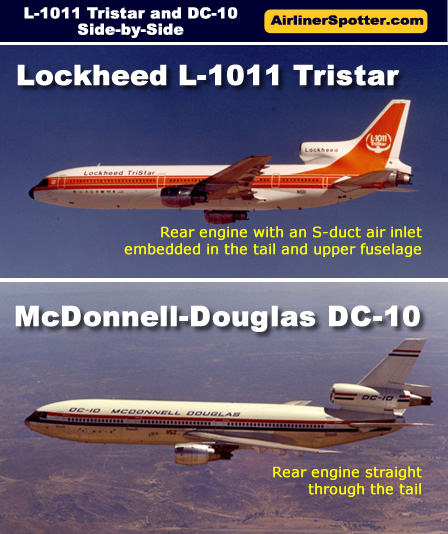 |
| The rival L-1011 TriStar and DC-10 looked alike, but that's where the similarities ended. For starters, the DC-10's third engine was mounted above the fuselage and did not use an S-duct. [7] |
As Harrington-Cressman has noted, “The L-1011 and DC-10 followed the same basic brief, but the engineering methods for each aircraft were extremely different. McDonnell Douglas tended to be more conservative in its approach to building its first wide-body aircraft – in many ways, the DC-10 was simply DC-8 technology that was enlarged and modernized in certain respects. Lockheed, on the other hand, felt that the key to success in the market was to take the most advanced technology of the day and when that technology was lacking, Lockheed created it.” [2]
Lockheed's vision and fearless attitude toward research and development was shared by Bristol Aerospace Limited in Winnipeg, which was contracted in 1968 to produce the TriStar’s S-duct. Delivery of 350 units was due to begin in May 1970 and production was expected to last over 10 years.
The contract was an important one for Bristol, and required careful planning. A project team of key leaders from several departments was established early in 1969, and preparations included new facilities and a plant expansion to handle the work. Bristol had a technical representative at Lockheed’s plant in California who could expedite technical decisions and provide on-site liaison.
Dad was always proud of the S-duct job, and always wore an L-1011 tie clip on his Fraser tartan tie, along with his Lancaster bomber and gold Bristol Aerospace lapel pins.
Lockheed's vision and fearless attitude toward research and development was shared by Bristol Aerospace Limited in Winnipeg, which was contracted in 1968 to produce the TriStar’s S-duct. Delivery of 350 units was due to begin in May 1970 and production was expected to last over 10 years.
 |
| S-duct assembly area, Bristol Aerospace Limited, Winnipeg [8] |
 |
| In June of 1969 Dad and others from Bristol spent a week meeting with Lockheed's engineers in Burbank, California. |
Dad was always proud of the S-duct job, and always wore an L-1011 tie clip on his Fraser tartan tie, along with his Lancaster bomber and gold Bristol Aerospace lapel pins.
 |
| Clare Geddes and his friend Murray Fraser |
 |
| Bristol's L-1011 S-duct on display [8] |
The production of the S-duct “introduced to Bristol ‘clean room’ environmental techniques, along with special material testing, and shelf life control, as well as a complex materials procurement schedule and quantity plan for each batch run.” [8]
Special tooling and rigs were required in 1971 for the sound attenuation bonded honeycomb structure, and Bristol staff were trained in new techniques. A more sophisticated sound attenuation was redesigned for the duct-to-engine segment of the S-duct in 1978, when more powerful engines were used in the long-range version of the L-1011.
Bristol’s plant expansion and specialized equipment required a capital outlay of close to $750,000.
 |
| First shipment by road, Bristol Aerospace Limited [8] |
 |
| Bristol proved contract administrator Jim Richardson's claim that, "If it can be made -- we can make it." Winnipeg Free Press, May 13, 1970 [9] |
At the same time, though, McDonnell Douglas’ rushed DC-10 was not a total triumph. The airliner was racked with problems, and earned a reputation as unsafe. [9] Crashes killed hundreds, and design and maintenance were often at fault. Trouble with a cargo door latch, for instance, was a known flaw that was not corrected until it led to two serious crashes.
DC-10s were grounded by the FAA for 37 days in the summer of 1979 following the May 25 crash of American Airlines Flight 191 out of Chicago when an engine fell from a wing. That crash killed 273 people and remains the deadliest aviation accident in the United States.
However, tri-engine airliners were ultimately replaced with new planes with more powerful engines, like the Airbus, and the three-engine configuration became outmoded.
Passenger flights on DC-10s ended in 2014. Remaining DC-10s are still in use for hauling freight, mainly by FedEx.
The initial trouble with DC-10s and its poor reputation hurt McDonnell Douglas financially, as did lawsuits from crash victims’ families. In 1997 the company was purchased by Boeing Co., the world’s largest commercial aircraft maker, for $13.3 billion in stock. Boeing phased out production of the MD-11, preferring to focus on their 777 jetliner.
TriStars were withdrawn from service in the late 1990s in favour of the new Boeing 767s and Airbus models. The RAF used L-1011s in military tanker and passenger/cargo capacities until March, 2014.
The last commercial TriStar flight was operated by ATA Airlines, a small regional carrier in Iran, on January 7, 2019.
Currently, one L-1011 remains flying. Operated by Orbital Sciences and called Stargazer, its most recent flight was in October, 2019 to launch Pegasus rockets into orbit around the Earth.
Sources
[1] Wikipedia, “Lockheed L-1011 TriStar”
https://en.wikipedia.org/wiki/Lockheed_L-1011_TriStar
photo: https://en.wikipedia.org/wiki/Lockheed_L-1011_TriStar#/media/File:Lockheed_L-1011-1_TriStar,_Lockheed_JP5893645.jpg
[2] Peter J.M. Harrington-Cressman, “Requiem for a Trijet Masterpiece – the Lockheed L-1011” (September 30, 2015)
http://www.airlinereporter.com/2015/09/requiem-trijet-masterpiece-lockheed-l-1011.tristar
[3] Lockheed's L-1011 theme song, c. 1970 on YouTube
https://www.youtube.com/watch?v=CxRW-P3kvF4
[4] “L-1011 Tristar – too advanced for us” (September 19, 2018) YouTube video
https://www.youtube.com/watch?v=dAjezUfdBXE
[5] “This Plane Could Even Land Itself: Why Did The L-1011 Fail?” (October 24, 2017) YouTube video
https://www.youtube.com/watch?v=jkFYD7R_Xig
[6] L-1011 Rolls-Royce RB211 engine, photo for sale on eBay (retrieved January 10, 2020)
https://www.ebay.com/itm/ROLLS-ROYCE-RB-211-ENGINE-LARGE-ORIGINAL-VINTAGE-PHOTO-LOCKHEED-TRISTAR-L-1011-2/193131716162?hash=item2cf78c1e42:g:nOEAAOSwzHBdh7Hv
[7] L-1011 compared to DC-10
https://www.airlinerspotter.com/mcdonnell-douglas-dc10-md10-md11-spotting-guide.htm
[8] 50 Years of Technology 1930-1980, Volume Two: The Second Quarter Century, Bristol Aerospace Limited, pp. 52-55
[9] Winnipeg Free Press, May 13, 1970, p. 84
[10] “What Happened to the McDonnell Douglas DC-10?” (May 23, 2017) http://www.wheresmychampagne.com/mcdonnelldouglasdc-10
[11] “How This Plane Earned A Dangerous Reputation: The DC-10 Story” (September 28, 2018) YouTube video
https://www.youtube.com/watch?v=l-085TjhUPo
https://www.youtube.com/watch?v=dAjezUfdBXE
[5] “This Plane Could Even Land Itself: Why Did The L-1011 Fail?” (October 24, 2017) YouTube video
https://www.youtube.com/watch?v=jkFYD7R_Xig
[6] L-1011 Rolls-Royce RB211 engine, photo for sale on eBay (retrieved January 10, 2020)
https://www.ebay.com/itm/ROLLS-ROYCE-RB-211-ENGINE-LARGE-ORIGINAL-VINTAGE-PHOTO-LOCKHEED-TRISTAR-L-1011-2/193131716162?hash=item2cf78c1e42:g:nOEAAOSwzHBdh7Hv
[7] L-1011 compared to DC-10
https://www.airlinerspotter.com/mcdonnell-douglas-dc10-md10-md11-spotting-guide.htm
[8] 50 Years of Technology 1930-1980, Volume Two: The Second Quarter Century, Bristol Aerospace Limited, pp. 52-55
[9] Winnipeg Free Press, May 13, 1970, p. 84
[10] “What Happened to the McDonnell Douglas DC-10?” (May 23, 2017) http://www.wheresmychampagne.com/mcdonnelldouglasdc-10
[11] “How This Plane Earned A Dangerous Reputation: The DC-10 Story” (September 28, 2018) YouTube video
https://www.youtube.com/watch?v=l-085TjhUPo


