Although the appellation "horse trader" often carries a negative connotation, no Fraser would consider it a slight. At least four of the six Fraser brothers - Will, John, Gordon, and Pete - were horse traders. And trainers. And drivers. And showmen. And farmers. Dad wrote in his 2003 history that "horses were important to the Frasers" and this posting is his.
The talk with visitors was always about horses, often race horses. Will and John Fraser both raced in the east, and Pete and Gordon Fraser owned race horses out west.
 Will Fraser with an unknown racehorse. Harness racing allowed the Frasers to drive for many more years than thoroughbred jockeys could.


John Fraser's horse, Black Patch, Ridgetown, Ontario

Will Fraser tears up the track with Billy Hugo, 1934
Will Fraser trained many fine racehorses, including Blue Again. "Blue" won the $50,000 Santa Anita Handicap in California. That was a princely sum in the mid-1940s!

Will Fraser with another fine specimen.

Unlike his brothers, Pete Fraser preferred large draft horses, and was known for his prized Percherons.
Pete Fraser had a purebred Percheron stallion named Julius. He took Julius to the Royal Winter Fair in Toronto in 1928. Jack Wallace, then a boy, went with him.

"Down Memory Lane" column in the Pilot Mound Sentinel Courier, Nov. 29, 1988, recounted Pete's award for his Percheron "Julius" at the Toronto Royal Fair in 1928.

Murray and Pete display ribbons won by their Percherons.
We also had a standard bred stallion named Graham Worthy (harness race horse stock), circa 1928. I made a garage for my Road King bicycle from the crate Graham Worthy came in.

Not every horse in the Fraser stable was a mighty Percheron or a speedy race horse, as young Murray Fraser shows.
Julius was travelled around the country by Jack Tole. When Jack broke a leg, circa 1928, he was cared for in our downstairs bedroom.
Jack was from Crystal City, the town south of Pilot Mound, and was proud of it. Hired hand Mr. Handford told Jack, "Crystal City is better laid out than Pilot Mound." Jack beamed until Handford added, "because it's been dead longer."

Pete Fraser (left) with Dougal Graham, the funeral director. Pete drove the classy glass hearse for Dougal for many years, with two black Percherons with net blankets for show. Schoolmate Honor Graham told Dad that Pete upset and smashed the glass hearse. Myra Fraser (Dad's cousin and Gordon Fraser's daughter) told Dad, "No, Dougal got his own horses, and he upset the glass hearse!"

Percherons in funeral finery tower over other horses.
Prairie Prince replaced Julius circa 1936. This Percheron would get bound up (constipated) standing in a box stall at the back of the cow barn (not Julius' quarters). The treatment was the bazooka, a funnel approximately 10" in diameter inserted into about three feet of heater hose. The hose was inserted into the appropriate orifice, and a half pail of water, dipped from the water trough, was poured down the funnel. The result was fast, fast relief.
One summer, 1939, Tom Gorrell ran out of gas opposite Frasers'. Tom was a very abrupt, nervous man. He asked, "Have you got any gas?"
I said, "The can is here, but it's empty."
Tom said, "There's gas in the car!" The bazooka was serendipitously hanging on the wall beside the car. Tom grabbed the hose, stuck one end in the '29 Plymouth' gas tank, and sucked on the other end to siphon gas into the can. It seemed too late to tell him what the hose was used for.

Lulu Bond
Pete was reported to have won a race horse, Lulu Bond, in a raffle. He had purchased a ticket, but hadn't won the draw. He actually bought the standard bred mare from the winner. The idiots who had tried to train her had tied a rope to her front leg and would trip her, afraid she might run away. Naturally, Lulu was a trembling, nervous wreck. Dad hitched her, tied back between two big Percherons, in a four-horse abreast team. She soon calmed down and pulled her weight. Pete may have hoped she might race, but that didn't happen.

Graham Worthy, in front of (Thomas) Gordon Fraser's livery barn (which he bought in 1929), Railway Avenue, Pilot Mound. Patrons paid maybe 25¢ to have a team of horses stabled for an afternoon's shopping trip into town.
One time Graham Worthy got untied from his stall and got in with Prairie Prince. There was a hell of a ruckus. I went over the manger alongside with a pitchfork and prodded Graham back to his own stall.
Graham got loose another time and chewed the back of a cow. Too much testosterone, I guess.
John Kelly drove Graham at stud around the country.

Jess
A colt from a Percheron mare became a utility horse that could do field work, and lively enough to drive to town with a buggy or cutter.


The view's not great, but it got you to town.
Pete Fraser had some 20 head of horses into the '30s and '40s. Mosquitoes plagued man and beast alike, so he often made a smudge, a smoky fire. The horses and cows would stand in the smoke, which the mosquitoes and flies didn't like.
Pete was proud of being able to plough a straight furrow, and had the awards to prove it! This story made the front page of The Pilot Mound Sentinel, June 25, 1925.

From the front page of the Pilot Mound Sentinel, June 25, 1925
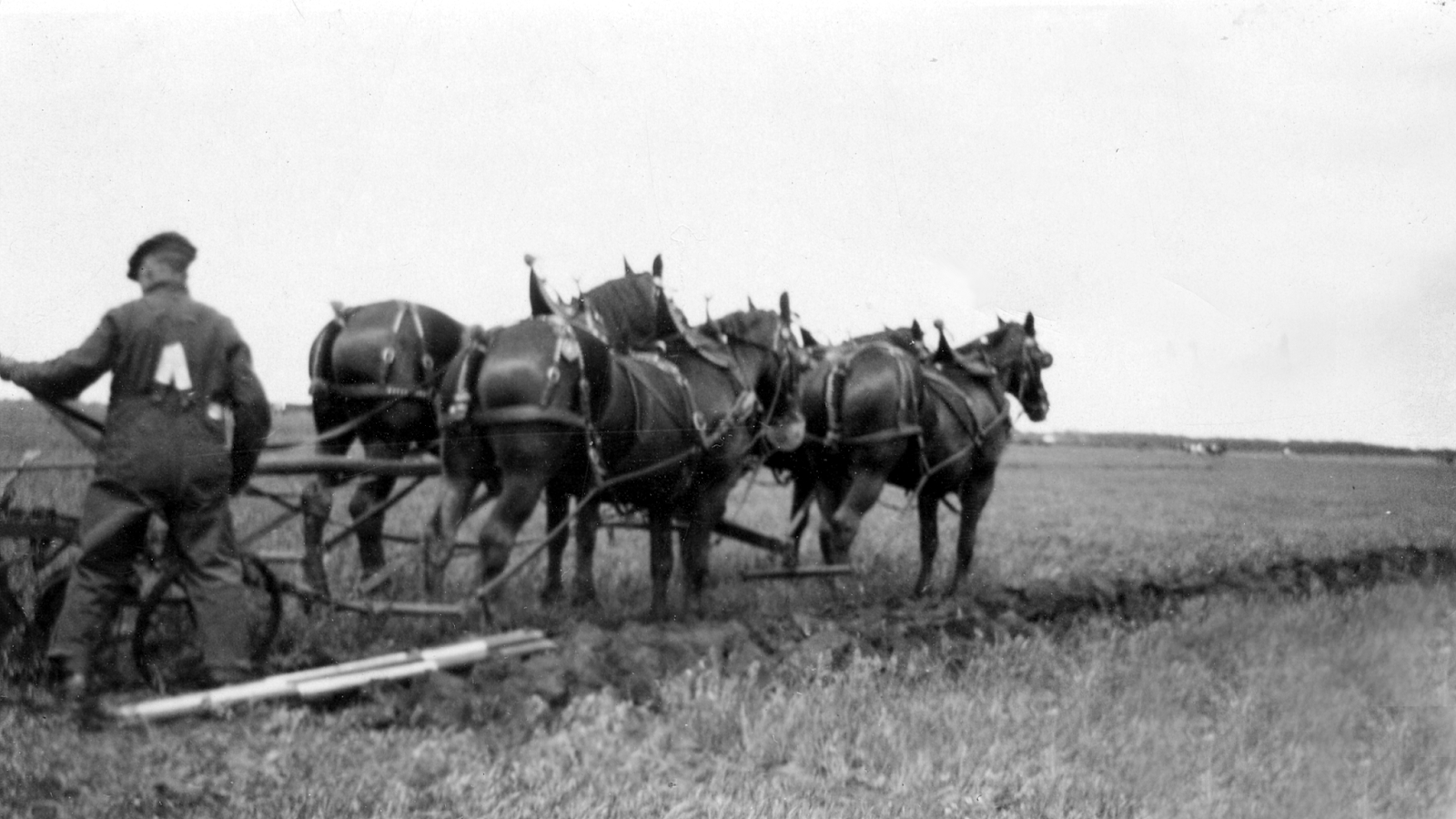
Pete and his four-horse team of Percherons

Pete driving a furrow straight and true.

A score card from 1923. Pete noted his wins on the back of the card: "Special Best four-horse outfit $5.00. Best finish four-horse outfit $5.00."
On winter days horses would be let out of the barn and would go to eat a straw stack in the East 40 acres. One day one of a team stood away from the feeding side of the straw stack. The message was clear: We need help here! Her teammate had got down and couldn't get up. We went down with a team and a rack, tied a chain to the downed mare's leg and pulled her to better footing so she could get up.

Pete dwarfed by his Percheron team in their show harness. These horses are typically over 6 feet high at the shoulder, and weigh about 2000 pounds.

Pete with Belle
In the early 1900s there was a neighbour to the west of Frasers' farm whose last name was Mead. He was not a licensed veterinarian, but had apprenticed in England and was better qualified than some with degrees. Sometimes he was called for help. He said, "In Canada it's horses first and last, but in England it's man first and man last. I'll be over when I've finished my breakfast."
One diagnosis: "It's the liver. When the liver stops, everything stops."

Pete with Bill
Uncle Gordon had a horse medicine called Dr. Bell's Veterinary Medical Wonder. A teaspoon would cure a horse -- powerful stuff! Uncle Gordon had some other horse medicine that his son Doug called "stink balls." Rotten kid -- stomping one made a great stink!

Uncle Gordon (right) with son Gordie and Harvest Pilot, 1957
Pete's younger brother Gordon was a lifelong harness race trainer and driver who travelled all across North America with his horses. Dad once said that Gordon might have won more races if he hadn't been so reluctant to use the whip.
A horse named Billy Democracy was one of Gordon's best winners. Dad and his sister Jessie drove "Old Bill" to school in the '30s. He was a pacer and wore hobbles when racing. Pacers had a wobble gait, in which the left (or right) pair of legs moved in unison.
Billy Democracy was lazy. He would not waste energy. There was no starting gate in his era. The starter would ring a bell if the pole horse was not in the lead and all would have to go back and start again. Nervous horses would be up and around the first turn before the drivers could get them reversed. When they again turned toward the start line, Bill was revved up -- he once took the tires off the cart doing a fast U-turn.
The horse wouldn't go a bit faster than needed, but any other horse would have to go some to pass him. For all his laziness he was a keen competitor. He would not eat his oats the day of his race, but how could he know?

Dougal McColly with Minnie Duff

Murray rides a Percheron, ca. 1938, with Pete on the scuffler, cultivating or hilling potatoes. Bill and Net were the chore team of dappled grey Percherons.
Pete Fraser owned horses even after he had motorized vehicles on the farm. You might say they were an expensive hobby. The passion was not shared by son Murray. If Dad had been interested in horses, he would have built one out of aluminum.

A chip off the old block. Two-year-old Wally Fraser in 1953, looking right at home astride what is likely a Percheron. Mom's note on the back reads "Horses were plowing the garden that day."
The Percheron Breed
(See more at Wikipedia)

Clare Geddes would probably call the Percheron the Charolais of horses. Bigger than other breeds, you might call them high and mighty.
The draft horse originated in the former Perche province of western France, where they were present by the 17th century. Earlier origins are unknown. They are known for their strength, intelligence and willingness to work. Percherons are typically gray or black in colour, still preferred by breeders today.
The breed was originally developed as a war horse. Their strength and gentle nature made them ideal for all kinds of hauling and agricultural chores. Percherons were used to pull stage coaches. Gray horses were preferred because they were more visible at night. French knights favoured the breed. Sadly, their musculature also meant they were bred in France for their meat.
There was a market for this breed in the U.S., as war horses during the Civil War in the 1860s, and for general draft and agricultural work. Approximately 7500 Percherons were exported to the U.S. in the 1880s. In 1906 France shipped over 13,000 horses to the United States.
The Percheron became the preferred draft horse in America. "Drivers appreciated the breed's agility, stamina and quick-footed gait." This may explain why they were often owned by travelling circuses, and not just as draft horses. Their strong, wide backs made a steady platform for bareback riders.
In the late 1800s, Percherons were used to pull horse-drawn buses in English and American cities. Retired teams would be sold to farmers. Always a good war horse, the British Army shipped 325 Percherons to South Africa for their use in the Boer War.

The Percheron team at the Assiniboine Park Zoo, in their new McFeetor's Heavy Horse Centre
Other major draft horse breeds in the early 1900s included the Belgian, the Clydesdale, and the Shire. Breeding stock in Canada and U.S. was very expensive.
During World War I, the French placed an embargo on the export of Percherons. The shortage led to a breeding boom in North America, and Percherons were shipped to France as much-needed, and favoured, war horses.
It wasn't just their strength and willingness to work that made the breed a good war horse. "The lack of feathering on the Percherons' lower legs made them easier to care for in the mud that they often worked in during wartime. Their quick trot on paved roads made them more versatile than motorized vehicles, and they were useful for work with guns and in forward units due to their calm temperaments."
By the 1930s the Percheron was the preferred draft horse in the U.S., making up over 70% of the purebred draft horses in the country. There were over 33,000 Percherons in the U.S., well over three times as many as the second most popular breed - the Belgian. The Percheron was favoured because of its "strength, energy, activity, robustness and endurance."
Predictably, horse numbers declined following increased mechanization after World War II, but breeders revived the interest in the 1980s. In France, the focus between 1970 and 1990 turned from draft chores to the production of meat, selecting larger and heavier stallions for breeding.
The Percheron remains the most famous and populous of all French draft breeds. They are still versatile and well suited to pulling carriages, and are used for sleigh rides and hayrides, and in parades. At Disneyland Paris, Percherons make up one-third of the park's horses, often seen pulling trams.
Not just a draft horse, purebred Percherons are also ridden, and some have even competed as show jumpers. Crossbred Percherons have been used in dressage.
Check out some amazing footage of famed showman Jason Goodman driving a six-horse team while standing on their backs!
Budweiser has its Clydesdales, but hauling pickles and ketchup required draft horses, too. Henry Heinz was a horseman in his day, and the company regarded Percherons as the Cadillac of horses. Click here to watch a 22-minute feature about the famous eight-horse Heinz Hitch, a popular attraction in the Rose Bowl Parade, the Calgary Stampede, and elsewhere. Sadly, the company decided to shut down its expensive Heinz Hitch, and in 2007 their horses were donated to Arlington National Cemetery. The stately Percherons will do a magnificent job in funeral processions there.
(By the way, did you know the Budweiser Clydes were originally from Winnipeg? A local blogger has traced them back to Shea's Brewery.)
Sources:
1) Murray Fraser, The Frasers (2003)
2) Wikipedia: https://en.wikipedia.org/wiki/Percheron
3) McFeetor's Heavy Horse Centre: http://www.assiniboinepark.ca/zoo/home/explore/exhibits/mcfeetors-heavy-horse-centre
4) Jason Goodman, Percheron Thunder: https://www.youtube.com/watch?v=V1Lo8rBLdSY
5) Heinz Percherons, HorseFlicks: http://www.tvg2.com/videos/horseflicks-the-heinz-percheron-hitch
6) Heinz Hitch Donated to Arlington Cemetery: https://simplymarvelous.wordpress.com/tag/heinz-horses
7) Budweiser Clydes' Winnipeg Connection: http://westenddumplings.blogspot.ca/2012/02/budweisers-clydesdales-their-winnipeg.html
3) McFeetor's Heavy Horse Centre: http://www.assiniboinepark.ca/zoo/home/explore/exhibits/mcfeetors-heavy-horse-centre
4) Jason Goodman, Percheron Thunder: https://www.youtube.com/watch?v=V1Lo8rBLdSY
5) Heinz Percherons, HorseFlicks: http://www.tvg2.com/videos/horseflicks-the-heinz-percheron-hitch
6) Heinz Hitch Donated to Arlington Cemetery: https://simplymarvelous.wordpress.com/tag/heinz-horses
7) Budweiser Clydes' Winnipeg Connection: http://westenddumplings.blogspot.ca/2012/02/budweisers-clydesdales-their-winnipeg.html